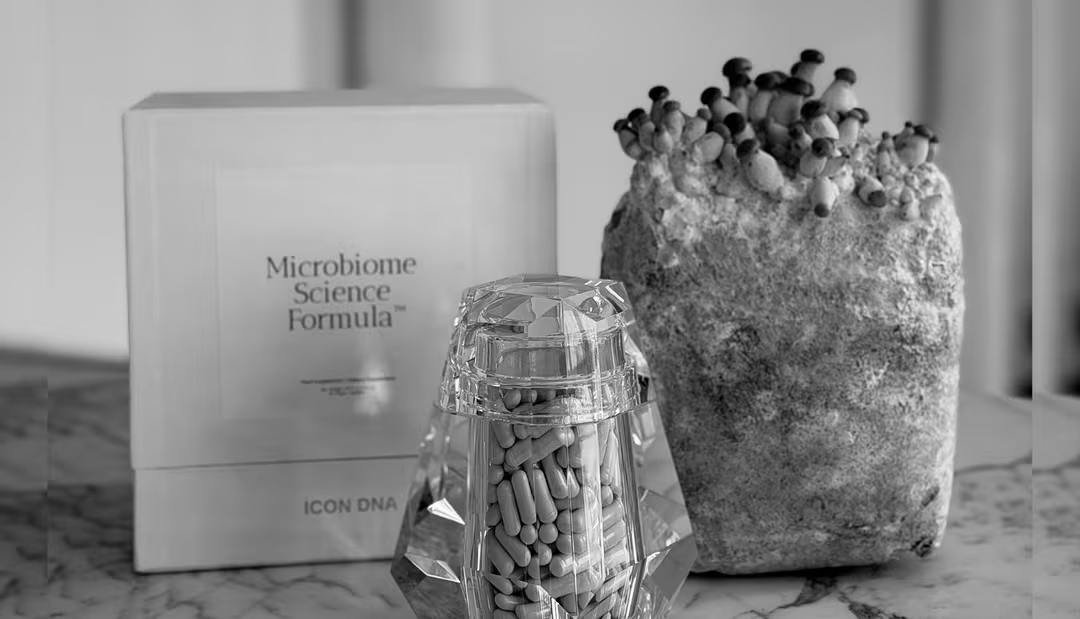
Mushrooms are among the most mysterious elements of nature – with unique properties that science is still exploring and uncovering. They are neither plants nor animals, but belong to their own kingdom – fungi – and an increasing number of studies confirm their potential in human health, longevity, and wellbeing. This potential forms the foundation of the business model of the Latvian innovative, science-driven startup “Imperia Organic”, which focuses on creating high-value niche products in the fields of functional food and biopharmaceuticals.
The company’s founder and Chairman of the Board, Uģis Zemturis, describes it simply – the core of his business is mushrooms, more specifically Eringi – a mushroom with a high concentration of bioactive compounds and distinctive taste properties. The company cultivates these mushrooms in its own production facility, ensuring full quality control throughout the entire process – from cultivation to the final product. In collaboration with Latvian scientists, in-depth research has been carried out over several years to understand the properties of bioactive compounds found in mushrooms and to develop methods for transferring them into high value-added products in a gentle and consumer-safe way.
“Mushrooms are a unique raw material, containing bioactive substances whose potential is still being explored by science. In our case, we do not really talk about direct competitors – there are mushroom extracts and powders on the market, but most are not based on in-depth scientific research. Moreover, more than 95% of these raw materials come from China, are purchased, packaged, and sold under a brand. We have chosen a different approach – we grow the mushrooms ourselves and, based on research, create products with clearly defined properties and controlled quality. These are innovative, high-value niche products designed for customers who appreciate both a science-based approach and excellent taste, as well as traceability of origin,” says Uģis Zemturis.
The company’s functional food line “Mush DNA” currently includes two products – mushroom cocoa and mushroom protein. Mushroom cocoa combines naturally occurring bioactive compounds in mushrooms with high-quality organic cocoa. The product contains no added sugar and is produced using gentle processing methods to preserve the natural properties of the raw materials. Its functional profile is formed by naturally occurring substances in mushrooms, including vitamin D (D2), beta-glucans, and dietary fibre, creating a balanced and high-quality product. Meanwhile, mushroom protein is positioned as a product for athletes and active lifestyle enthusiasts seeking a high-quality, functional alternative to animal and plant-based protein products.
At the same time, Uģis Zemturis emphasizes that a functional product must not only be well-designed in terms of composition but also enjoyable to use, which is why particular attention is paid to taste. “Usually, mushroom cocoa or mushroom coffee is not particularly tasty, and manufacturers try to mask it with cinnamon, cloves, and other additives. We have taken a different approach – to develop a product that is genuinely delicious. It is no coincidence that Michelin-star chefs appreciate it and include our products in their dishes.”
The company’s second parallel line of activity is dietary supplements in capsule form, which is a logical continuation of the functional food line. While mushroom cocoa and mushroom protein deliver functional properties in a food format, capsules provide the same properties in a concentrated and precisely dosed form.
“In dietary supplements, the main ingredients are mushroom extracts obtained in various ways – they are dried, processed into powder, and filled into capsules. This way, there is no need to consume large quantities – a single capsule contains concentrated vitamin D and valuable beta-glucans,” explains Uģis Zemturis.
The mushrooms used in the products are grown in a substrate made from secondary raw materials, such as wood chips and bran, and the company has found a way to turn this by-product into another innovative and potentially promising business direction. In cooperation with the Latvian State Institute of Wood Chemistry, a unique biocomposite material without artificial chemical compounds has been developed from this substrate, which could in the future be used in the creation of design objects and furniture.
“Imperia Organic” has built its business model with a clear focus on export – its products are positioned in the highest quality and price segment. For example, the price of a dietary supplement in crystal packaging exceeds €1,000, meaning the local market is not the company’s primary target. This also determines a different approach to sales and cooperation with clients.
“We do not create mass products – we deliberately work with a solvent audience that values a science-based approach, clear origin, and quality. Therefore, we do not even think in terms of ‘countries’ – sometimes we are more interested in specific cities or even particular districts where our customers are concentrated. This also defines our business model – sales largely take place through B2B channels, building long-term cooperation with the health and wellness sector,” says Uģis Zemturis.
Currently, the company’s main markets are Spain, the United Arab Emirates, and the United States, although development in the latter has become more cautious due to trade uncertainties. A significant achievement is recognition from exclusive health centres in Spain (such as “SHA”, often referred to as one of the best wellness and SPA centres in the world), where dietitians and nutrition specialists have reviewed the product composition and properties and included them in their offerings. At the same time, “Imperia Organic” products have also entered Michelin-level restaurant menus – not as standalone products, but as ingredients in chefs’ gastronomic concepts.
Currently, “Imperia Organic” is a participant in the business incubation programme of the Investment and Development Agency of Latvia (LIAA) representation in Talsi, which Uģis Zemturis highlights as one of the key stepping stones for structured growth and the use of available development instruments.
In the coming years, the company’s development strategy is pragmatic and gradual – to strengthen product sales, arrange certification and registration in target markets, and only then consider increasing production capacity and expanding the product portfolio. The company deliberately builds growth on a solid foundation, based on research and a long-term vision of the market. As Uģis Zemturis emphasizes, the next two to three years will be dedicated to ensuring stable cash flow and developing new, science-based products.
The article was developed within the project “Development of Innovative Entrepreneurship of SMEs”, co-financed by the European Regional Development Fund and the European Union.