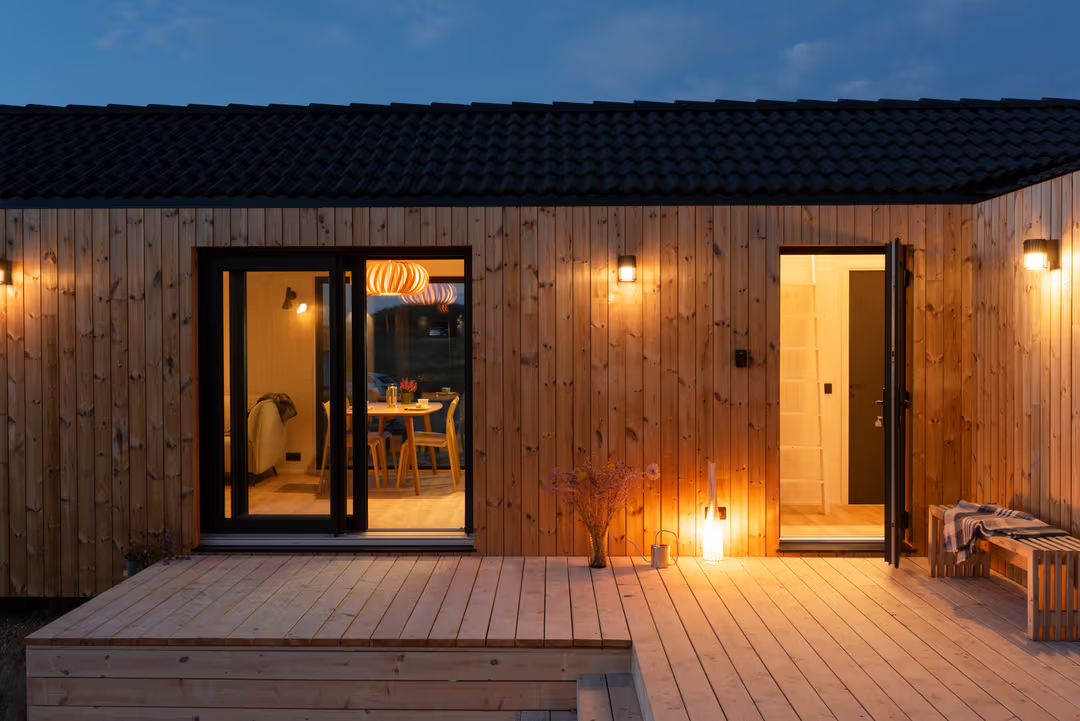
The Latvian company MLK Houses positions itself not as a traditional modular home brand, but as a high value-added manufacturing partner for international clients. The company specialises in producing modular houses for other brands, focusing on the hospitality sector — hotels, resorts and nature tourism projects worldwide.
“We deliberately chose not to enter the market with our own brand but instead adopted a so-called white-label approach. We manufacture for companies that already have a brand and are looking for a reliable, high-quality production partner, while we concentrate on what we do best — manufacturing, quality and a tailored approach,” explains MLK Houses CEO Matīss Kuba.
The MLK Houses factory in Latvia has been operating for three years and is currently fully booked. The company’s 2026 production capacity is essentially filled, with main export markets in the Netherlands, the United Kingdom and Denmark. At the same time, the US market is rapidly developing and is planned to become the largest in the coming years. “This year is basically already planned out. Contracts are signed and international interest is only growing,” says Kuba.
The company aims to produce on average 5–6 modules — approximately 300 m² of finished product — per month in 2026. Each project is individually designed with different layouts, façades and roofing solutions, including timber, metal, green roofs and roofs with solar panels.
Specialisation — design and quality, not mass production
Unlike many modular house manufacturers, MLK Houses focuses not on mass production but on quality, customisation and architectural aesthetics, which are particularly important in the hospitality segment.
“Almost every project we build is unique. In this segment, architecture, aesthetics and quality are often decisive — that is exactly what defines our value to clients,” the CEO emphasises.
So far MLK Houses has built approximately 130–150 modules. The company’s modular homes — used for campsites, rental homes, offices and neighbourhood development projects — are made from cross-laminated timber (CLT). CLT is a sustainable and renewable construction material increasingly used in modern timber architecture worldwide. It provides high structural strength, good energy-efficiency properties and reduced environmental impact.
International supply chain and smart manufacturing
The MLK Houses production facility in Latvia currently occupies 800–1000 m². About 30 professionals work in production, while another 10–15 employees are engaged in administration and engineering.
The company operates as an assembly factory rather than a full-cycle woodworking enterprise. Components arrive pre-manufactured, including CLT panels, ensuring high flexibility and avoiding large investments in specialised equipment. CLT panels are supplied from Estonia, windows from Poland and some interior elements from the Netherlands. The company’s strategy is to eliminate intermediaries and work directly with manufacturers to maintain quality and cost control.
The US — a strategic next step
MLK Houses is fully export-oriented and is currently focusing particularly on strengthening operations in the United States, which is planned as the primary future market.
In the US the company has chosen a different approach — integration into local supply chains. This is mainly due to extremely high certification costs for finished modules, which in the US can reach up to €200,000 for the first module and €30,000–€50,000 for each subsequent one.
“In such conditions it is much smarter to manufacture panels in Latvia and assemble them locally in the US, integrating into another company’s supply chain,” explains Kuba.
Client acquisition strongly depends on management experience and personal involvement. Kuba emphasises that in the international B2B segment, face-to-face meetings and factory visits are the strongest deal accelerators. “When a client has visited the factory, the deal can almost be considered closed,” he says.
Key arguments also include real completed projects, ready-to-inspect modules and the availability of an engineering team.
Digitalisation and LIAA support for growth
In cooperation with the Investment and Development Agency of Latvia (LIAA), the company implemented the integrated management system MONEO last year, combining production, warehouse, accounting, finance and time tracking in one platform. The project’s goal was to grow without increasing administrative burden while maintaining control over costs and quality.
MLK Houses has also received incubation support from the LIAA Madona office, allowing the company to free up funds for research and international travel.
“In our experience and business model, foreign trips most often result in real deals — but they are expensive, especially in distant target markets such as the US,” says Kuba.
Although Latvia currently accounts for less than 1% of the company’s turnover, MLK Houses is exploring opportunities to participate in small residential village development projects locally, inspired by concepts seen in the US.
The article was produced within the project “Development of Innovative Entrepreneurship in SMEs”, co-financed by the European Regional Development Fund and the European Union.