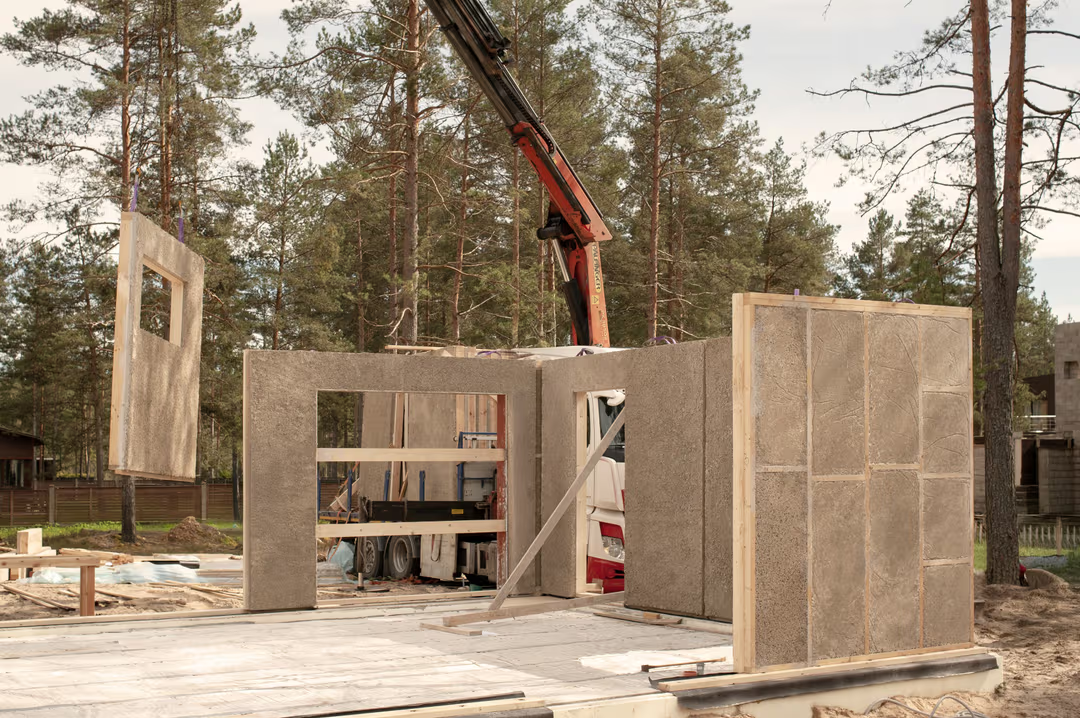
Latvian start-up FURE Biostone produces innovative biostone wall panels from hemp and lime – a sustainable alternative to traditional building materials. This biostone allows you to create homes that breathe, maintain a healthy microclimate and reduce your carbon footprint. The company was founded in 2024 by four like-minded individuals – Jānis Nīgals, Didzis Piļāns, Austris Kozuliņš, and Uldis Baumanis – who shared a vision to create a good product for people and to develop the field of sustainable natural construction in Latvia. In its first year of operation, the company has set up a pilot production facility, attracted its first customers, and begun collaborating with architects who incorporate biostone into their projects.
“We want natural construction to become the norm, not a niche,” says one of the company’s founders Jānis Nīgals. “The industry is dominated by quick and cheap solutions, which often cause long-term problems for both human health and the environment. We are offering an alternative which is natural, safe, and durable.” Another important aspect is that these “cheap” solutions lead to more expensive problems: the need to repair the structure of the house, or healthcare costs for people whose health has been damaged, e.g., because of mould, but FURE Biostone is a long-lasting investment with lower operating costs, and it creates a safe environment for people.
The biostone developed by the company and used in its wood frame panels, consists of hemp fibres and a special lime mixture. Hemp is one of the fastest growing plants in the world, and its stem is porous, like wood, making it an excellent heat and sound insulator. Lime, on the other hand, is a natural binder that hardens over time, becoming stronger, like limestone.
“Biostone is breathable, but at the same time very heat-resistant,” explains Jānis. “It helps maintain optimal humidity levels, is fireproof, non-toxic, does not cause allergies, and even repels pests. In addition, it does not cause mould and is completely recyclable and compostable.”
Not only does this material not pollute the environment, but it even purifies it by absorbing CO₂ from the atmosphere. Thanks to these properties, biostone is increasingly being used in ecological construction projects across Europe, both for new buildings and for the insulation and renovation of historic buildings. Our research shows that demand in the European market for this type of natural building material is growing rapidly. Specifically, the hempcrete market in Europe is forecast to grow by an average of up to 5.6% per year, driven by EU regulations on green construction and energy efficiency. FURE Biostone is positioning itself as a player in this growing, future market.
From idea to development plan with the help of an innovation voucher
To move from idea to actual product, FURE Biostone used the innovation voucher programme of the Investment and Development Agency of Latvia (LIAA). This helped the company to thoroughly research the biostone production process, storage requirements, and technical details.
“As they say, the devil is in the details,” Jānis Nīgals admits. “Before this project, we didn’t know much – what the production facility should look like, what equipment we needed, how to store lime and hemp, how to combine these materials into a single product – a finished prefab wood panel. The voucher allowed us to understand all of this, as well as to develop formulas and technical solutions that prove the advantages of our material over others.”
The project ran from the fall of 2024 to the spring of 2025, and as a result, the company not only opened a pilot production facility, but also developed a structured business plan and long-term development strategy. Market research conducted as part of the program allowed the company to gain a detailed understanding of production costs, demand dynamics, and export potential.
Now, the company’s pilot production facility in Līgatne manufactures custom-made prefab wood panels with biostone filling, where the wood provides the load-bearing function and the biostone provides thermal insulation and acoustic comfort. The company is also testing various production methods and automation solutions at their plant. FURE Biostone has also managed to establish cooperation with several leading Latvian architects who specialise in sustainable construction and include biostone as a material in their projects.
“The first pilot houses using biostone have already been built in Latvia. Our first customer was an active entrepreneur who managed the construction of his own private home and wanted to see the advantages of this material in practice. The feedback has been very good,” Jānis says.
FURE Biostone is currently in the process of attracting investments to develop production in Latvia. The company has established strategic contacts with partners in the United States, Canada, and Sweden, and plans to bring the new material to international exhibitions soon.
Hemp – Latvia’s green gold
The company hopes that the development of biostone production will give a positive boost not only to sustainable construction, but also to the development of a new direction in agriculture in Latvia. “Hemp is a very promising plant in Latvia’s climatic conditions,” emphasises Jānis Nīgals. “It grows very quickly, does not require pesticides, and improves soil quality thanks to its deep root system. This means that next year, other plants will be much more productive in the soil improved by hemp. Hemp can be used in more than 25 000 types of products, from building materials to food, textiles, and even interior panels for cars. We hope that as the business develops, we will be able to purchase the necessary materials – hemp shives – right here in Latvia, rather than importing them.
The natural construction industry in Latvia is still in its infancy. Many companies that have tried to operate in this field have ceased operations, and there is currently a shortage of both local raw material processing and certified material production facilities on the market. FURE Biostone wants to change this by fostering a local ecosystem and collaborating with researchers, architects, and farmers. “France is a leader in hemp construction – the industry has been developed there for decades,” Jānis says. “We want Latvia to become a similar example in the Baltics. We have nature, scientists, and enterprising businesses."
Information material prepared with the support of the European Regional Development Fund