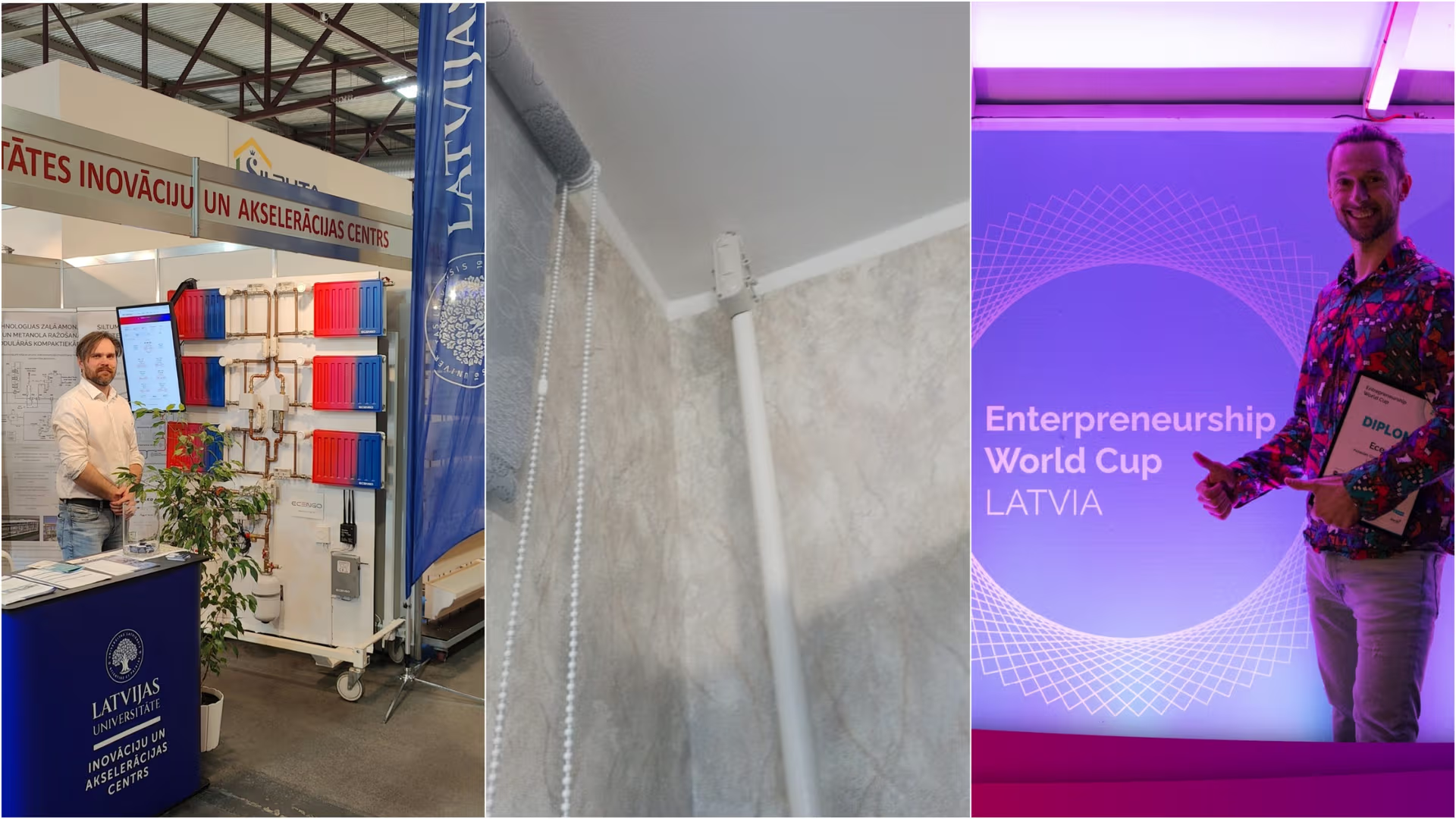
Who wouldn't want to turn down the heat before heading to the countryside and thus reduce their monthly bill? Many would love to pay only for their individual heat consumption, but in reality, this is often impossible—nearly 50% of apartment buildings in Latvia were built during the Soviet era. Almost all of them feature a single-pipe heating system with no regulation options, where the total bill is simply divided based on apartment floor area.
Jānis Eriņš, head of the company “Ecengo,” points out that these buildings are aging rapidly while heating prices continue to rise. Meanwhile, technology is developing at a breakneck pace, and it would be a "sin" not to use it to one's advantage. Ecengo has developed an innovative solution that allows for the precise determination of thermal energy consumption in apartment buildings with single-pipe systems, providing transparent data for both individual apartments and common areas.
“Our solution helps identify the building's weak points so that the first confident step toward renovation can be taken,” says Jānis.
A Solution That Opens Eyes
The story of Ecengo began 13 years ago with the idea for an alternative heat energy accounting system. Jānis Eriņš reveals that for about ten years, it was a “garage project” involving numerous prototypes and experiments. The company was officially founded in 2022, and the Ecengo team now consists of eight people.
The product offered is a Digital Heat Consumption Determination System (SPNS). This solution requires no changes to the building’s existing pipework because the SPNS sensors are installed directly onto the exterior of the heating pipes. These sensors measure the surface temperature of the pipe, dividing risers into segments to calculate the temperature difference attributable to a specific apartment. Each riser is also equipped with a flow meter to record the total volume of heat carrier. Data is then sent to receiving devices and uploaded to a digital platform, where specialized algorithms convert the readings into understandable units of thermal energy.
“It is difficult for all residents of a house to agree on a renovation immediately. The SPNS system acts as a roadmap—it shows what is actually happening with heat consumption in the building,” Jānis emphasizes. He notes that many residents lack a clear understanding of heat loss. “When people see specific numbers, questions arise: why is our consumption so high in the basement or stairwells? These questions are the beginning of change.”
In almost all buildings where the SPNS solution has been installed, residents have taken further steps, such as installing bypasses and thermostatic valves so each apartment can regulate heat based on comfort or budget. In several cases, residents have addressed critical issues or even completed full building renovations.
Digitalization: Not a Choice, but a Necessity
“We need to build a massive network of buildings and objects where data from sensors is collected. Our platform uses a special algorithm to recalculate sensor readings into kilowatt-hours. Imagine—data flows in from several hundred devices now, and in the future, it will certainly be thousands,” Jānis explains.
He recalls that the company previously used a data platform that wasn't quite fit for purpose. With support from the Investment and Development Agency of Latvia (LIAA), they were able to purchase new data processing and process management software.
“The feeling was like switching from a Zhiguli to an Audi. Now we have broader data processing functions, we can connect to external systems, and automate processes. It makes you wonder—why didn't we do this sooner?” Jānis laughs.
He strongly believes that any manual, repetitive task performed by a human at a computer should be automated to ensure fewer errors and higher quality. “Digitalization is a never-ending process. It cannot be postponed for the future; it is a necessity for today.”
A Breakthrough Thanks to LIAA Support
LIAA support played a crucial role in the company's digital transformation. They have since:
Purchased laser engraving equipment to create unique QR codes for every sensor.
Developed a mobile app for installation management, eliminating the need for manual note-taking and reducing human error.
Acquired software to integrate the data platform with their accounting system.
“This digitalization project has significantly improved our internal processes and allowed us to work more efficiently,” he concludes. “I encourage other entrepreneurs to seize these opportunities. Apply for LIAA support; it’s not as complicated as it seems. You learn by doing, and the people at LIAA are very responsive and helpful.”
This project is co-financed by the European Union Recovery Fund (NextGenerationEU) under the Cohesion Policy Programme 2021–2027. The article was funded with the support of the Recovery Fund.