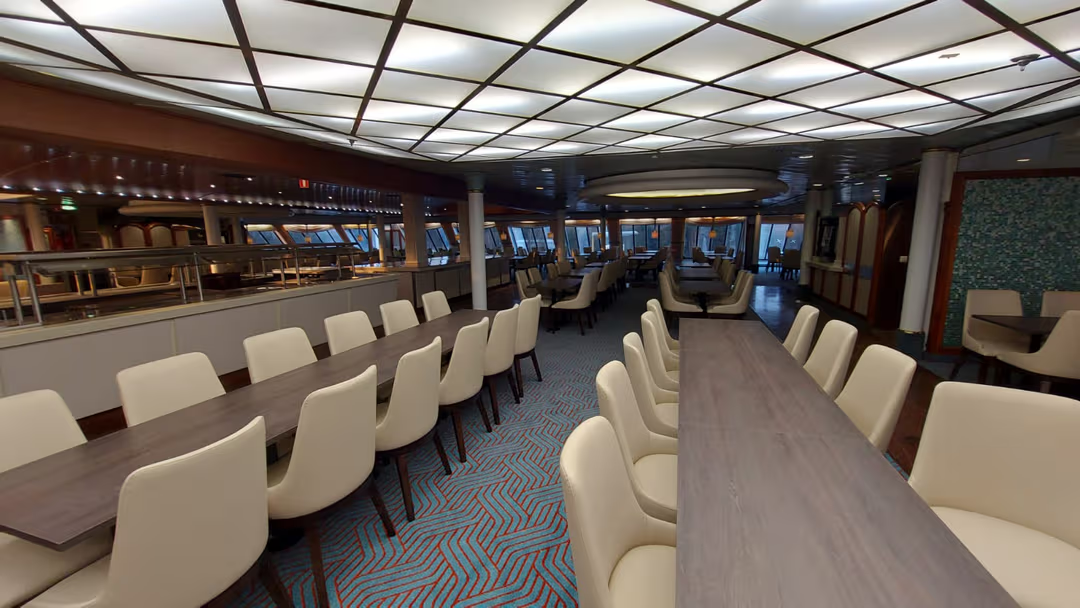
The Rēzekne-based company SMART Interior manufactures case and interior furniture for ships. Its scope of activity covers the full cycle—from design and production to complete installation on board. The company is involved both in equipping new vessels and in renovation projects. Founded in 2019, the company is led by Viktors Ivanovs, who has been working in the ship-interior field since 2007. Initially, the company specialised solely in furniture installation, and it was hands-on experience that revealed the key problem: furniture intended for ships was often of poor quality, complicating installation and causing issues during operation.
“I saw that the quality wasn’t what it should be. And then the idea arose—why not manufacture it ourselves? If we can install it, we can also make it,” says the company’s CEO.
Furniture for ships is highly specialised—it is designed to withstand vibration, movement, moisture, and saltwater. Such equipment requires specific materials and technologies, including fire-safety, impact-resistant and moisture-resistant solutions, as well as fastening systems that ensure stability even in heavy seas.
The knowledge and contacts accumulated in this niche enabled the company to secure its first orders soon after its establishment. The initial projects proved very successful, allowing SMART Interior to acquire specialised production equipment and open a manufacturing facility in the Rēzekne Industrial Park.
Although the company’s early years coincided with the pandemic, SMART Interior managed to grow without relying on the state support mechanisms available at the time. From the outset, it also operated within the LIAA Business Incubator in Rēzekne, actively using the programme’s opportunities—co-financing for equipment purchases, development of marketing and visual materials, rental of premises, and various training programmes. According to the company’s management, this support was one of the factors that helped the business overcome a difficult period more confidently and sustainably.
Focus on exports
Today, the company not only produces deck and interior furniture for ships—cabins, restaurants, and leisure areas—but also offers customised interior and furniture solutions for private clients and real-estate developers. However, this direction accounts for only a small share of total output, as the company’s core specialisation remains ship interior outfitting. Approximately 60–70% of production is exported, with the main markets being Estonia, Lithuania, France, Finland, and Germany. The company’s clients are primarily shipbuilding and outfitting firms, with whom it implements large-scale international projects.
Notably, the well-known Baltic ferry Tallink’s “Isabelle”, which now operates on Canadian routes after refurbishment, was equipped with furniture manufactured by SMART Interior. In addition, in cooperation with Estonian partners, the company has provided furniture installation services for Royal Caribbean cruise ships. “I can say with pride—furniture made in Latvia is sailing seas all over the world today,” emphasises V. Ivanovs.
The company acknowledges that competition in the market is currently most strongly influenced by Chinese products—they are significantly cheaper, but their quality often fails to meet the required maritime standards. This is why SMART Interior focuses on high-quality solutions and technological advantages.
A new direction: solid-wood furniture production for the Swedish market
The company is also working on another potential development direction—manufacturing solid-wood furniture for homes, offices, and timber-frame housing construction, with a particular focus on the Swedish market. In the future, such products could also potentially be used in the luxury segment of ship outfitting.
To implement this idea, a new production facility of 2,000–2,500 m² is required, as the existing premises are not suitable for expansion. Investment in construction and equipment is estimated at around EUR 1 million, and discussions with potential investors from Sweden are currently underway.
As the company notes, one of the key future challenges in developing this area will be attracting qualified labour. “In Rēzekne, there are not many specialists with experience in working with solid wood—if local specialists have any woodworking experience, it is mostly with particleboard. Therefore, recruiting staff will be one of the biggest challenges, and we are considering attracting employees from nearby cities,” the company’s CEO explains.
The preparation of this article was financed by the European Regional Development Fund under the sub-project of the SME Incubator Programme.