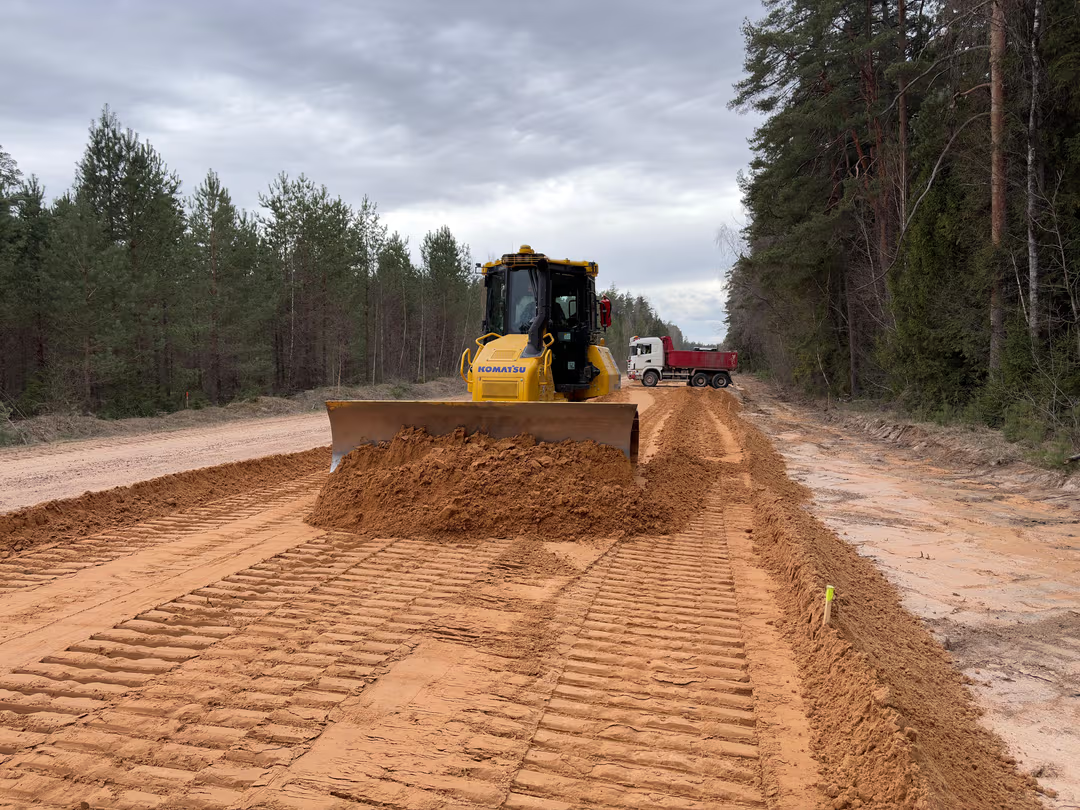
In the construction industry, the saying “time is money” is not just a metaphor—it is a harsh reality. Material costs are constantly rising, and there is also a shortage of skilled labor, so companies must look for solutions that not only save money but also enable faster and more efficient work. Kristaps Ļaudams, project manager at the road construction company “BL grupa,” emphasizes that digitalization cannot be postponed—even a single excavator or compact loader equipped with a 3D system can significantly improve a company’s competitiveness.
A large-scale project requires innovative thinking
Founded five years ago, “BL grupa” builds roads, площадes, and industrial facilities. Their daily work includes excavation, construction of crushed stone layers, digging foundations and ditches, building embankments, installing engineering utilities, and many other tasks.
Project manager Kristaps Ļaudams has been with the company since 2021 and oversees all construction processes—from acquiring clients and signing contracts to material procurement and quality control. Spring and summer are the busiest periods: “In winter, we prepare cost estimates, participate in tenders, and expand our equipment and machinery fleet,” he explains. Although the team consists of only 20 people, by working with subcontractors, “BL grupa” is able to implement even very large projects.
One of the biggest challenges was constructing nine poultry houses and a production facility complex for “Balticovo.” Kristaps reveals that from the very beginning he understood that a 3D automation system was essential. “Before concreting the barn floor, a perfectly even crushed stone base must be created. If the base is uneven, the difference has to be filled with concrete, which is very expensive nowadays. To avoid significant concrete losses, precise base preparation is a critical stage.” Such equipment is rare and in high demand in Latvia, so relying on rental was not an option—the company decided to purchase it.
One person instead of an entire crew
“To build sites and roads with precision, with support from the Investment and Development Agency of Latvia, we purchased ‘Bobcat’ compact loaders, a grader blade, and the ‘Trimble’ 3D system. It is an automatic leveling system that adjusts the grader blade height to level crushed stone with millimeter accuracy!” says the project manager. “Even if people spent a month leveling with rakes, they could not achieve this level of precision. This investment is truly invaluable.”
The construction project is uploaded remotely into the system, and the machine determines its position using sensors, masts, and base stations. This equipment can be used both outdoors and indoors, and Kristaps notes that this 3D system is currently one of the most precise solutions available worldwide. “Of course, we need every piece of equipment immediately, so waiting for the project application evaluation results was difficult, but we managed everything and used the system in the construction of the poultry houses. This technology is most effective when building large buildings and hangars, which is our specialization. It can also be used before asphalt paving. As asphalt prices are rising, millimeter-level precision helps prevent waste of expensive materials.”
The large-scale digitalization project was implemented with support from the Investment and Development Agency of Latvia (LIAA). Total investment amounted to €190,000, of which €50,000 was co-financed by LIAA. “Friends told us about the opportunities offered by LIAA. We didn’t hesitate and immediately submitted a project application. It really wasn’t complicated—I think anyone could do it. And €50,000 in co-financing is very tangible support.”
A website – the company’s digital business card
With LIAA support, the company recently launched its website, with total project costs of nearly €10,000. The result has already paid off—thanks to the job vacancies section, they have found a new employee.
“For all these five years, the company actually didn’t have a website. Now we can inform clients about updates and showcase our completed projects. We have also created a special section—a bulk material delivery calculator. Clients can calculate the cost of sand and dolomite aggregate delivery at any time based on distance. It saves time for both us and our clients—the price can be determined in seconds without making a call.”
“Digitalization is an effective way to tackle labor shortages,” Kristaps says openly. “We also have excavators equipped with 3D systems—now one person sitting at a monitor can do the work that previously required an entire team. Moreover, this equipment allows us to participate in tenders with lower prices without compromising quality. If a competitor doesn’t have such equipment, they will either overspend on materials or require more labor resources. Competitiveness definitely decreases without such technologies, so digitalization is an absolute necessity. The shortage of human resources and rising material costs force us to invest in technologies that ensure precision and efficiency,” explains Kristaps Ļaudams.
“What would I recommend to other entrepreneurs? To competitors, I’d say—do nothing, invest somewhere else,” Kristaps jokes. “Digitalization is not only our future but also our present—you simply cannot do without it. Use the opportunities available, otherwise your competitors will!”
Latvian entrepreneurs have access to a wide range of state and European Union-funded support for business development, available on the unified business portal business.gov.lv and its subsite liaa.business.gov.lv. There, companies can find information on various programs—from funding for innovation and new product development, export promotion, and international cooperation to grants for digitalization, technology adoption, and productivity improvement.
The project is co-financed by the European Union Recovery Fund (NextGenerationEU) under the Cohesion Policy Programme 2021–2027. The creation of this article was funded by the Recovery Fund, and the views and opinions expressed are solely those of the author(s) and do not necessarily reflect those of the European Union or the European Commission. Neither the European Union nor the European Commission is responsible for them.