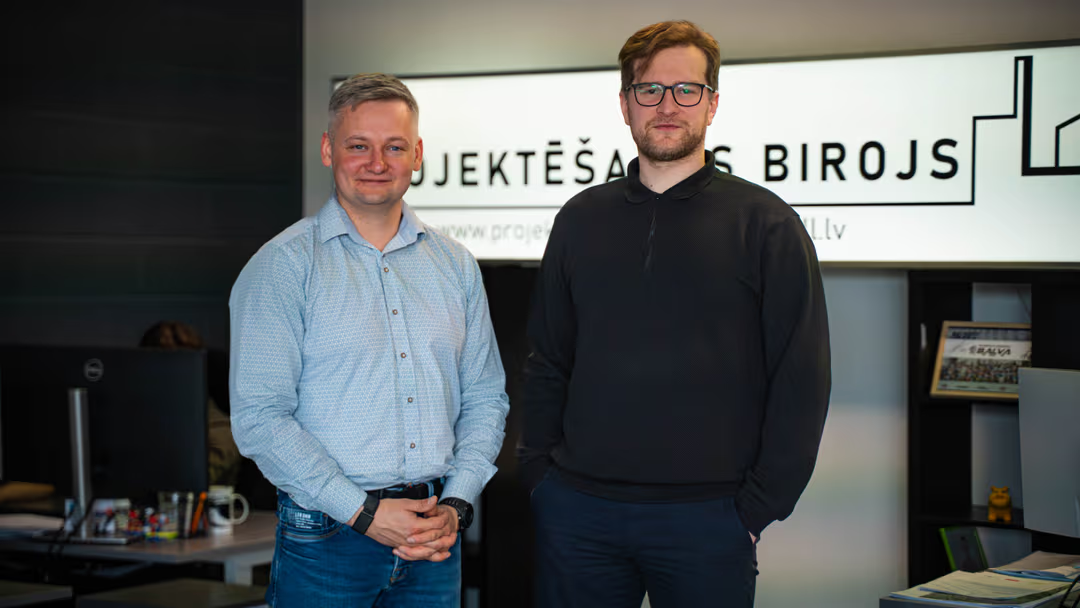
Doing things faster and better is no longer optional for a modern, growth-oriented company. In 2023, when SIA “Projekti LL” completed boiler house construction projects at record speed—from contract signing to commissioning in just six months—company manager Lauris Lazdiņš realized that future success would require innovation. To ensure seamless collaboration between structural engineers, architects, and designers, the company introduced a new structural engineering software, RFEM.
SIA “Projekti LL” is a design company based in Valmiera and one of the largest in the region. Over the past four years, it has experienced rapid growth. Starting as a two-person team focused solely on engineering systems design, it has grown to 13 employees and now offers full-cycle construction project development—from A to Z. This includes structural design, architecture, engineering systems, heating, water supply, electrical systems, and other technical solutions.
The company completes around 100 projects per year. To meet deadlines, it became necessary to improve workflows by adopting modern tools for structural analysis, design, and Building Information Modeling (BIM). After evaluating options and consulting engineers, Lauris Lazdiņš concluded that a high-level BIM solution—RFEM by developer “Dlubal”—would save time and resources.
Goodbye to Manual Excel Calculations
Structural engineer Agris Rogainis recalls that earlier tools used during studies were often graphically outdated and “pixelated.”
“They provided good data on internal forces and deformations, but didn’t clearly indicate whether results complied with specific standards. That had to be checked manually,” he explains.
Previously, calculations often required manual input in Excel spreadsheets, followed by redrawing in another program. With RFEM version 5, many of these inefficiencies have been eliminated.
“With RFEM, we can calculate steel structures and foundations within one system. We no longer need separate paid software for different calculations,” Rogainis adds.
Many manual processes are now automated. The software performs load calculations, checks limit states, and ensures compliance with standards automatically. Results can be obtained within minutes—or even seconds for simpler elements. Even complex building models rarely take more than 10 minutes.
For large projects, this reduces months of work to just days.
“If we didn’t have RFEM, we would need to hire additional staff just for routine tasks. Skilled structural engineers are already scarce, so automation is essential,” says Lauris Lazdiņš.
Flexibility and Efficiency in One System
Since engineers work daily with steel, concrete, and timber 3D models, RFEM’s modular functionality is a major advantage. The company can use only the tools it needs and purchase additional modules when necessary.
This approach also reduces costs, as only a maintenance fee is required annually.
Support for Growth Beyond Latvia
Investing tens of thousands of euros in digital tools during a growth phase was financially challenging. However, support from the Latvian Investment and Development Agency (LIAA) through the Recovery and Resilience Facility digitalization program enabled the company to acquire the RFEM license.
“With this support, we’ve become more competitive. Automation allows us to offer better pricing and faster delivery. It also helps us expand beyond Latvia,” says Lazdiņš.
RFEM includes built-in Eurocode standards and national annexes, which engineers would otherwise need to source manually. The software allows quick adaptation of designs to requirements in Estonia, Lithuania, or other countries.
“As we enter the Estonian market and sign new contracts, this functionality is crucial. We don’t need to study new standards from scratch,” he explains.
Fewer Errors, Better Results
RFEM also helps prevent costly design errors. It highlights critical issues in the model—such as structural clashes or insufficient space for equipment—before construction begins.
The software also calculates material quantities more precisely, reducing overestimation common in manual calculations. This leads to cost savings for clients by minimizing excess materials.
Clear Results in a Short Time
Although the company has used RFEM for less than a year, the benefits are already evident. The team can handle more projects, meet deadlines consistently, and produce clearer and more accurate 3D models.
This success encourages further digitalization initiatives aimed at improving internal processes and helping clients implement construction projects more effectively.
Latvian businesses have access to a wide range of national and EU-funded support programs, available through the unified business portal “business.gov.lv” and its subsite “liaa.business.gov.lv.” These include funding for innovation, export development, international cooperation, digitalization, and productivity improvements.
The project is co-financed by the European Union’s Recovery Fund (NextGenerationEU) under the Cohesion Policy Programme 2021–2027. The views expressed are those of the author(s) and do not necessarily reflect those of the European Union or the European Commission, which are not responsible for them.