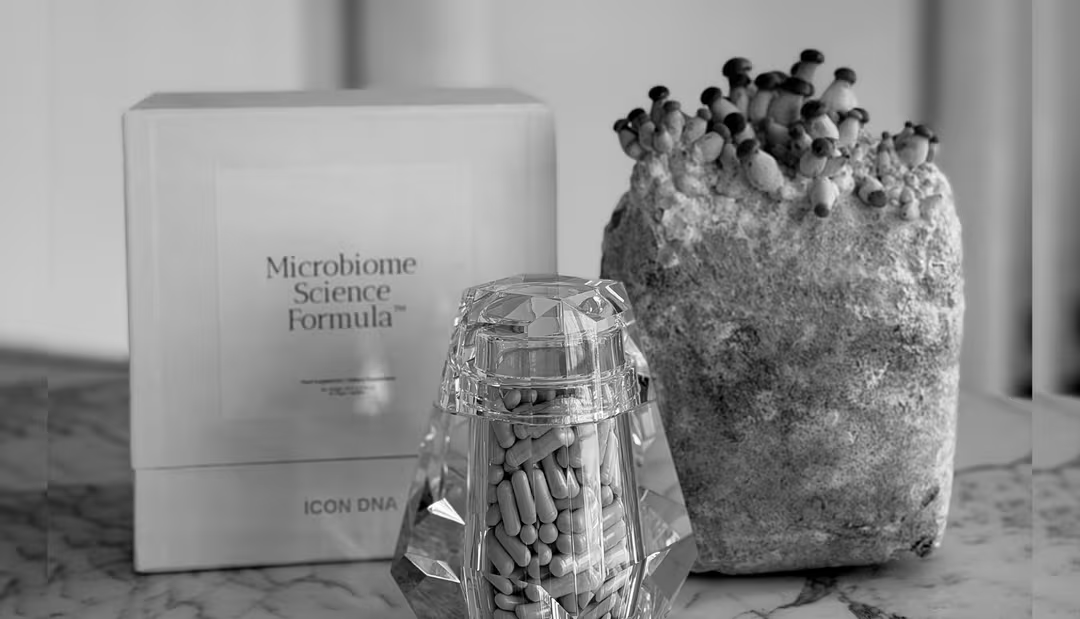
Latvia’s Imperia Organic is an innovative, science-based startup that builds its business model around self-grown mushrooms and their bioactive properties. The company develops high value-added products in the fields of functional food and biopharmaceuticals, with a clear focus on export markets. Imperia Organic products are currently sold in markets such as Spain, the United Arab Emirates, and the United States, working with high-end wellness centres and Michelin-level restaurants.
Since its founding five years ago, the company has developed in close cooperation with the Investment and Development Agency of Latvia (LIAA), which it evaluates very positively overall, highlighting both the wide range of support instruments and the professional approach. Cooperation with LIAA began with innovation vouchers, which enabled co-financing of scientific research in collaboration with Latvian scientists, and later continued through the business incubation programme at LIAA’s Talsi representative office.
“When you look at it overall, there are actually so many support opportunities that it can sometimes be difficult to choose what to use. The programmes are very diverse – for innovation, digitalisation, export, exhibitions, training. It’s impossible to make use of everything,” says the company’s founder, Uģis Zemturis.
The company sees particular added value in the business incubation programme, which provides not only financial support but also a structured environment for growth – including co-financing for equipment, access to training, and networking opportunities. Uģis Zemturis especially highlights training opportunities, including on the use of artificial intelligence in business, as well as LIAA support for participation in international exhibitions:
“Participation in national stands at international exhibitions provides a huge boost – both financially and in terms of the quality of contacts. These are not cold calls, but people who are already interested in the sector. Real contacts and cooperation emerge there.”
At the same time, the entrepreneur openly points to challenges, mainly related to administrative and bureaucratic processes after project implementation. According to Uģis Zemturis, reporting and documentation requirements are often equally extensive regardless of whether the funding amount is small or large.
“Whether you are reimbursing one thousand or one hundred thousand euros, the requirements are often the same. There have been cases where I simply chose not to submit a claim for smaller amounts, even if I could, because the time and costs involved would exceed the benefit,” he explains.
Zemturis emphasises that this approach particularly affects small businesses and startups, where one person often performs multiple roles – from management and finance to marketing and sales. At the same time, he acknowledges that most processes are digitalised, which significantly facilitates cooperation.
Despite these critical aspects, Imperia Organic evaluates its cooperation with LIAA as very good overall. “If I had to rate it from one to ten, I would give a solid eight. The attitude, service, and interest from LIAA are very good. The support is real – the question is more about how to further simplify the process for small businesses so they can devote more time to business development rather than bureaucracy,” says Uģis Zemturis.
This article has been prepared within the framework of the project “Development of Innovative Entrepreneurship for SMEs”, co-financed by the European Regional Development Fund and the European Union.