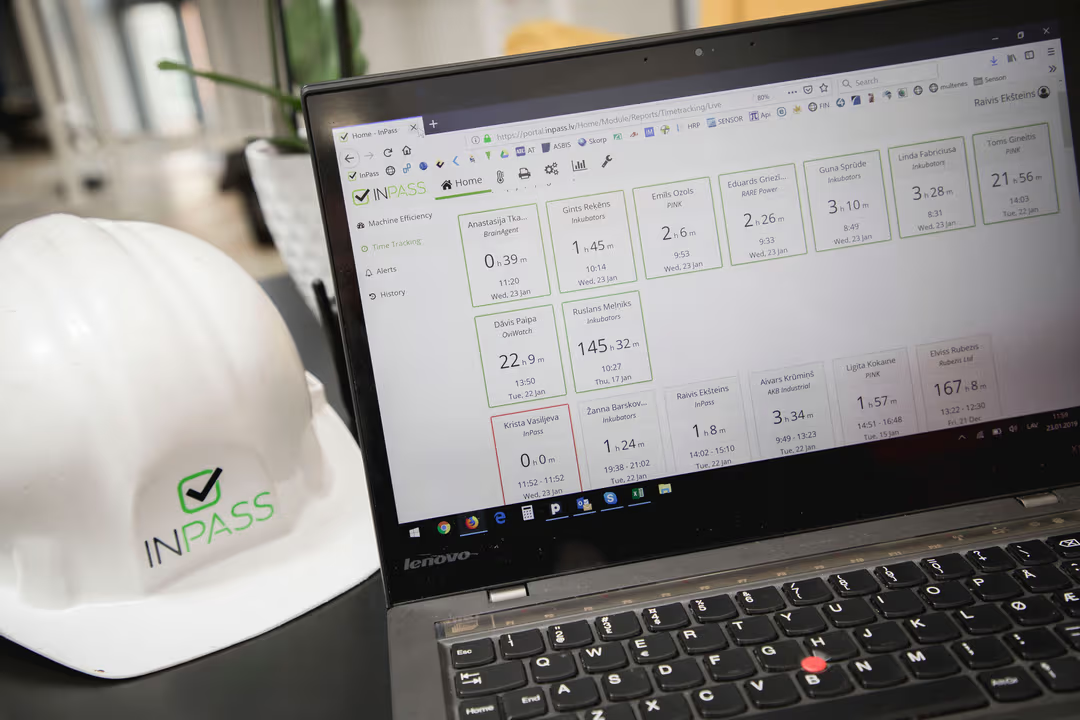
When the Liepāja-based technology company InPass says, “Anything that can be measured can be improved,” it is not just a marketing slogan — it is the core of their business and the essence of their services. InPass develops time tracking, monitoring, and data analytics systems that help companies register working hours, optimise processes, and improve safety. The solutions can be tailored to the needs of a wide range of industries — from manufacturing and logistics to offices, museums, schools and other organisations where precise and reliable oversight is required in daily work.
Today, such electronic solutions have become essential tools for companies, enabling decision-making based on objective data rather than assumptions. Detailed insights into equipment operation, downtime, and production intensity help identify inefficiencies in time and make targeted improvements. Meanwhile, time tracking systems ensure access control, safety, and convenient linking of working hours with payroll calculations, significantly reducing administrative burden. As a result, companies become more transparent, structured, and productive — especially in sectors where precision and process efficiency directly impact final results.
A journey that began at the LIAA office in Liepāja — and quickly grew into an independent success story
InPass was founded in 2017, originating from the Liepāja office of the Latvian Investment and Development Agency (LIAA), where it received incubation support. Over eight years, the company has grown from a small startup into a stable market player with 10 employees, and this year’s turnover is expected to reach around EUR 500,000. The growth has been achieved entirely through the company’s own resources, without attracting external investors.
A major advantage of InPass is its ability to provide a complete solution cycle — the company develops and assembles the required devices in-house and also programs and maintains its own cloud platform for data processing. “Our greatest value is that we create everything ourselves. Unlike many competitors who only sell imported modules, we are not limited by ready-made solutions. This allows us to think broader and deliver exactly what the client truly needs,” emphasises CEO Raivis Ekšteins.
This ability to tailor solutions to each company’s specifics is also the reason why manufacturers such as Kurzemes gaļsaimnieks, Latvijas Finieris, Lauma Lingerie, and Primeks use InPass technologies. Solutions have also been implemented in educational institutions, clinics, laboratories and other organisations where accurate tracking and reliable processes are crucial. The company is particularly proud that among its clients is also the Latvian Investment and Development Agency itself.
Solutions that enhance efficiency
InPass services cover several areas, one of the most significant being the measurement of manufacturing equipment utilisation. A proprietary microcontroller is connected to a production line and records operating time, downtime, output and other key parameters. Employees log downtime reasons in a mobile app, and all information is collected in a unified cloud platform, where it becomes a clear map of processes, highlighting loss points and areas with optimisation potential.
Another key area is time tracking systems — particularly valued in construction, manufacturing and service sectors, including schools, laboratories, and medical institutions. These solutions track working hours, manage access to premises, and easily integrate data with accounting systems. In construction, they have become essential due to regulatory requirements and can be supplemented with specific safety solutions, such as breathalyser access checkpoints at construction sites.
The third area is environmental monitoring — continuous tracking of temperature, humidity, and other parameters. This solution is widely used in the food industry, where compliance with EU regulations and quality standards is critical. InPass provides 24/7 monitoring with automatic alerts if parameters deviate from the norm — preventing potentially large losses, as even a minor temperature fluctuation in a warehouse or freezer overnight can cost thousands of euros.
State support as an accelerator of growth
Innovation vouchers from LIAA have played an important role in the company’s development, enabling faster prototype development and specialist recruitment. In one project, state support helped attract a highly qualified programmer, significantly improving cloud platform functionality. In another, a new model of time tracking device was developed — one that operates anywhere with access to power, without a separate router or mobile internet. This lowers costs and reduces technical complexity for clients.
One of the most exciting current projects is a cooperation with foreign partners to develop a unique, mobile, handheld, drone-compatible solution for monitoring the condition of wooden electricity poles — “MUPSIS 2024”. Over the next three years, the aim is to build a prototype capable of analysing pole condition and identifying when replacement is needed. There are approximately 850,000 such poles in Latvia alone, and the US market is significantly larger — manual inspection creates enormous costs. “We see tremendous potential here. If the technology proves itself, it will be useful not only in Latvia or Scandinavia but anywhere where wooden pole infrastructure is still used in electricity networks,” explains Raivis Ekšteins.
Although Latvia remains the company’s main market, around 10% of turnover currently comes from exports. Activity is particularly strong in Lithuania, and presence is being expanded in Estonia and the United Kingdom. Next year, the company plans to enter Poland — a market that promises to be both challenging and full of opportunity.
“In Estonia, competitors are technologically very mature. That means we have to keep pushing constantly. But such competition only makes us stronger,” says Ekšteins. In the future, InPass also plans to use LIAA export support programmes to approach foreign markets more actively and strengthen its positions there.
The programme is financed under the European Union Cohesion Policy Programme 2021–2027, Specific Objective 1.2.1 “Strengthening research and innovation capacity and the introduction of advanced technologies for enterprises”, action 1.2.1.4 “Support for improving the technology transfer system”.