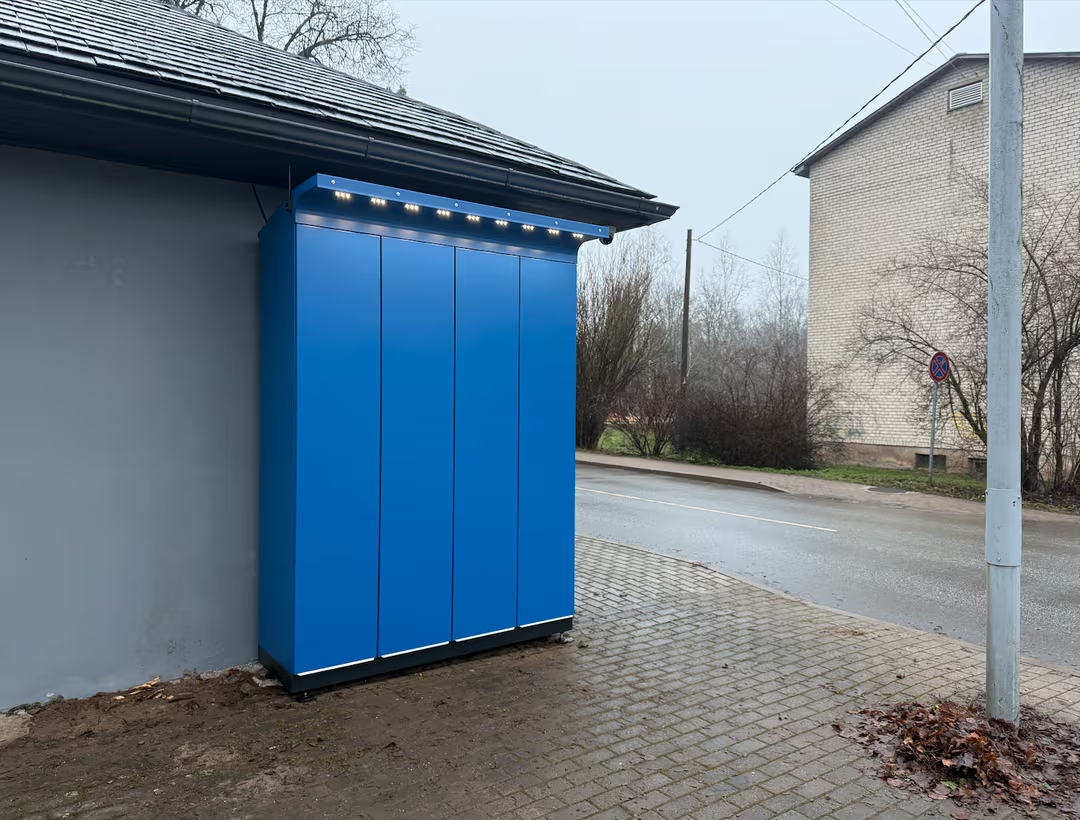
If we look around, it seems that almost the entire service sector is gradually moving toward self-service – from ordering food to booking services at a time that suits the customer. However, when companies try to put this idea into practice, complications often arise. This is especially true when it comes to equipment rental, access to warehouses, lockers, or parcel lockers without staff present. It is precisely in this niche that the Latvian technology company “Allockate” has found its place.
“Allockate” develops access control and self-service solutions that allow companies to automate access to lockers, parcel lockers, and warehouse premises. The company’s solution combines in-house developed hardware and software, and a key advantage is its modularity – the system can be adapted to specific needs or integrated into existing solutions without building everything from scratch.
The company was founded in 2023, and its original idea was quite different – a trailer rental platform with smart access. A mobile app, a platform, and prototypes of “smart” locks were developed, but it soon became clear that this direction was not sustainable. “The trailer market is small and fragmented, and customers often lack sufficient motivation to invest in complex technological solutions,” recalls Allockate founder Eižens Poišs.
However, working with customers revealed another, much broader problem – the market lacks easy-to-use, flexible access control systems that can be adapted to different businesses. As a result, Allockate pivoted to electronics and software development, focusing specifically on access automation.
The Allockate solution enables companies to provide secure and convenient access to premises or equipment: the customer books a service, receives an access code, arrives at a convenient time, opens a locker or parcel locker, and collects or returns the equipment – without face-to-face meetings, without key handovers, and without additional staff involvement.
“If we imagine someone renting, for example, a SUP board or a trailer via a popular rental booking platform – the reservation happens digitally, but in practice the owner still usually has to physically hand over the item. We simply remove this step, and this approach can be adapted to a wide variety of business models,” explains E. Poišs.
At present, Allockate has already implemented collaborations with four clients in Latvia. These include the self-service storage company Boxrent, the industrial products distributor Berner, the trailer rental company Amolat, which offers its service via a mobile app with trailers conveniently available at fuel stations, as well as a ski service company (for dropping off and collecting equipment for servicing).
In cases where a client does not yet have such lockers, they can be manufactured and installed from scratch – for example, in producing parcel locker housings, Allockate cooperates with Latvian metalworking companies.
The company places particular emphasis on the fact that its solutions can also be integrated into existing lockers by replacing mechanical locks with smart access. In the future, Allockate aims to become a supplier of access systems that other companies can easily integrate into their own products. “We want to move as quickly as possible to a model where we manufacture and supply the access system, and the client integrates it into their own solution. Conceptually – like separate modules that can be combined as needed: number of doors, connectivity, functions,” explains E. Poišs.
Over the coming years, the company’s goal is to cooperate with larger partners in Europe and the United States, where such systems can help introduce self-service solutions without disproportionately large investments in developing fully custom solutions from scratch.
Along its development path, Allockate has also made use of several state support instruments. In cooperation with the Investment and Development Agency of Latvia (LIAA), the company has used support available to startups for the remuneration of highly qualified specialists, as well as opportunities offered by the Latvian Digital Accelerator (LDA) – consultations and testing support. Looking ahead to the next development stages and export expansion, the company is currently also considering other support programs, including LIAA incubation support.
The program is financed under the European Union Cohesion Policy Programme for 2021–2027, within Specific Objective 1.2.1 “Strengthening research and innovation capacity and the introduction of advanced technologies for enterprises,” Measure 1.2.1.4 “Support for the development of the technology transfer system.”