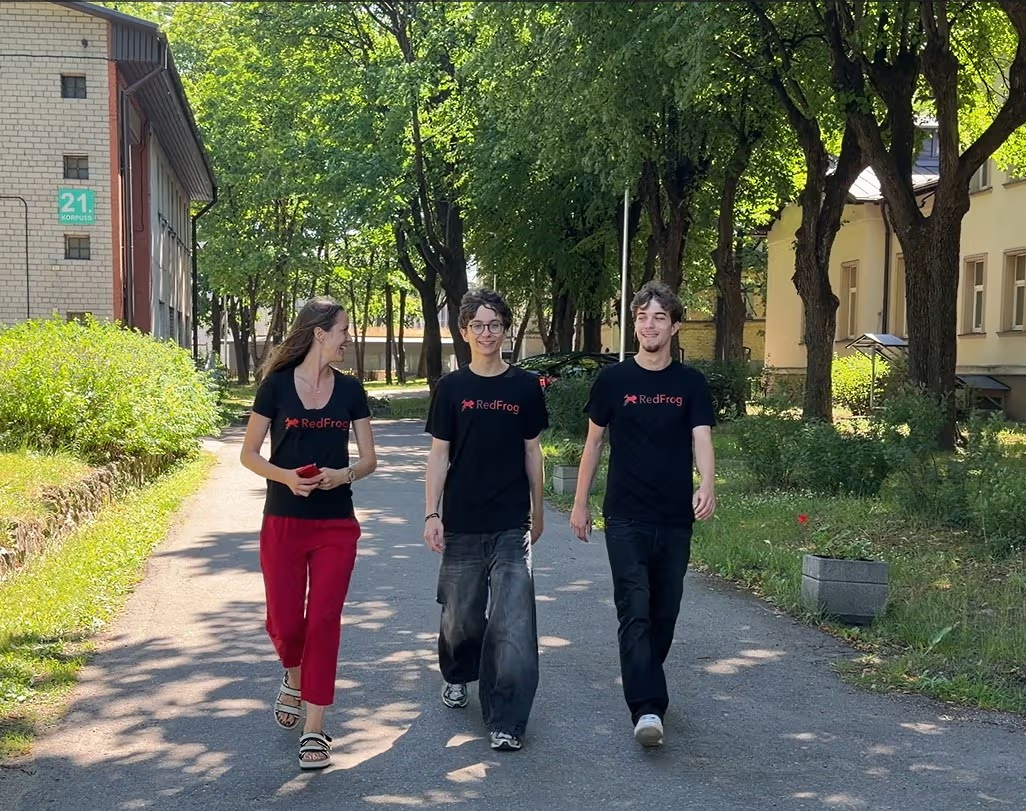
If everything had gone according to the original plan, “RedFrog” might be a very different company today. The idea began with augmented reality – at a conference, a person could raise their phone or use smart glasses and immediately see where an investor, potential business partner or another person of interest was located. However, the technology was not yet ready, users were slow to embrace augmented reality glasses, and conversations with potential customers revealed that the problem could be solved much more simply. The original concept gradually evolved into an indoor navigation solution for large buildings. Along the way, “RedFrog” has also made use of support provided by the Investment and Development Agency of Latvia (LIAA) – from business incubation and innovation support to opportunities for exploring new markets outside Latvia.
The original idea gradually evolved into the “Stride Navigation” indoor navigation solution, which helps people find their way around large and complex buildings – hospitals, university campuses, office complexes and other places where conventional GPS navigation no longer works.
One of “RedFrog’s” most prominent projects is currently being developed at Riga 1st Hospital. However, the company’s co-founder, Madara Kalniņa-Kalnmale, sees the Latvian market primarily as a place to test and refine the technology and demonstrate that it works. The company’s ambitions extend much further – to large buildings across Europe and the Middle East.
Ten Years in Augmented Reality and the Feeling That It Was Time to Build Something of Her Own
Before establishing “RedFrog”, Kalniņa-Kalnmale spent around ten years working for a company involved in the development of augmented reality technologies and glasses. It was there that she increasingly encountered one fundamental technological challenge – positioning.
For augmented reality content to appear in the correct location, the system needs to know precisely where the user is at any given moment.
“To display an image in a particular location, you need to know where you are at that moment. I spent ten years working at that company, and then I reached a point where I felt it was time to do something of my own,” Kalniņa-Kalnmale tells TVNET.
Together with Toms Žunns, who later became a co-founder of “RedFrog”, she began developing a new product. Initially, the concept remained closely linked to augmented reality.
For example, a person could arrive at a large conference looking for an investor and, by raising their phone camera, see information displayed above the people around them – identifying investors, potential business partners and other participants worth approaching.
The idea sounded impressive. However, once the team began developing a prototype, a problem quickly emerged – the required positioning accuracy was not yet technologically achievable.
If the technology is off by one metre and two people are standing next to each other, the augmented reality information could already appear above the wrong person.
“At that point, we realised that the technology was not yet where we needed it to be. If Ilzīte and Jānītis are standing next to each other and the information is shifted by a metre, Jānītis’ name could appear above Ilzīte’s head and vice versa. The user experience would then be quite poor,” Madara explains.
When a Complex Product Is Replaced by a Simpler One
The more the team spoke with potential customers, the clearer another conclusion became – people were not particularly eager for a future in which they would routinely walk around wearing augmented reality glasses.
Kalniņa-Kalnmale recalls that, after years of working in the industry, it was easy to find oneself in a technology bubble where augmented reality seemed destined to be everywhere in the near future. Outside the industry, however, the reality was different.
“We started talking to more customers and realised that we could actually simplify the product. People are still very happy to view information on their phone screens,” she says.
That led “RedFrog” to a much more pragmatic solution – indoor navigation.
Instead of displaying virtual information above people, the technology would help users find a room, reception desk, office, specific location or, where necessary, even a person. This shift significantly broadened the potential customer base.
Today, the company’s main customers are owners and operators of large buildings and complexes – hospitals, universities, office campuses and other organisations whose premises are used by large numbers of people every day.
“Essentially, we provide the same experience that people are used to with ‘Google Maps’ or ‘Waze’ outdoors. The difference is that our product works indoors – where GPS signals do not,” Kalniņa-Kalnmale explains.
In a Hospital, Nurses No Longer Need to Explain: Left, Right, Up the Stairs
One of the most immediately understandable applications of indoor navigation is in hospitals.
In large healthcare facilities, knowing the address of the building is often not enough. Patients need to find a particular reception desk, building, floor or consulting room, and frequently their first source of directions is not their phone but the nearest healthcare professional or member of staff.
“Our customer is the owner of a large building, but the user is any ordinary person. In a hospital, navigation is also about managing patient flows. A nurse rushing along a corridor no longer has to stop and explain: the X-ray room is over there, then turn left, then right, go up the stairs and it is the third room,” says Kalniņa-Kalnmale.
At Riga 1st Hospital, the “RedFrog” solution is intended to make the process even simpler – patients will not necessarily need to download a separate app.
Patients already receive a reminder before their appointment. A navigation link can be added to this reminder, opening a personalised route to the required location directly in the browser.
“Everyone understands that users do not want to download anything unnecessary. In the hospital’s case, we have an integration with its internal system. Before an appointment, the person receives a reminder together with a link. Once they click it, a route to the specific reception desk opens immediately,” the company’s co-founder explains.
The navigation system uses Bluetooth sensors installed throughout the building, enabling the user’s location to be determined even where GPS signals are insufficiently accurate or unavailable altogether.
The result on the phone screen follows a familiar principle – a dot that moves together with the user and a route leading to the destination.
More Than Just Finding the Right Room
Although the user’s main priority is reaching the right place, indoor navigation provides another valuable resource for the building owner – information about how people move through the building.
A hospital can analyse where people most frequently become confused, where congestion occurs and whether particular routes work as originally intended.
“Today, we all want data. We want to see how many patients went where, how they moved, where congestion occurred, where everything is working well and where perhaps a member of staff needs to be sent,” says Kalniņa-Kalnmale.
At the same time, the company emphasises privacy. The navigation system needs to know where a phone is located, but in the solution being developed for the Riga hospital, “RedFrog” does not need to know the identity of the person carrying it.
“For us, it is simply user X. We do not know whether it is Eva, Madara or Jānis. The hospital does not need to know whether it was specifically Eva who walked down a particular corridor either. What matters is understanding how patients move,” she explains.
Through its integration with the hospital’s system, “RedFrog” receives information that a patient needs to reach a particular consulting room, but the company does not receive personal data identifying that patient.
Latvia as a Testing Ground Before Exporting
Although “RedFrog’s” first major projects are being implemented in Latvia, the company has never intended to focus solely on the domestic market.
Kalniņa-Kalnmale describes Latvia as an excellent testing environment. The market is small, decision-makers are relatively easy to reach, and the company can test its technology across different use cases.
“We are from Latvia, and for us this is a testing ground. We can test different scenarios here. In Latvia, it is very easy to contact different types of customers – a hospital, university or another facility – and understand where else our navigation technology could be used,” she says.
One of the company’s projects to date has been at Riga Technical University’s Ķīpsala campus. In cooperation with RTU, the company is also exploring opportunities to incorporate additional solutions into the technology in order to further improve positioning accuracy in the future.
Projects in Latvia are also important for the company’s export ambitions. A conversation with an international customer is very different when, instead of merely showing a presentation, the company can invite them to visit and see a fully functioning solution in practice.
“Now that we already have customers in Latvia, it is much easier to approach export markets and say: come and see it for yourselves. We have something to demonstrate and references we can point to,” Kalniņa-Kalnmale emphasises.
The Largest Market Could Be Where People Escape the Heat Indoors
There is also a very practical limitation to the Latvian market – there simply are not that many truly enormous buildings.
Kalniņa-Kalnmale jokes that, of course, it is possible to get lost in a shopping centre in Riga as well, but the potential of the company’s technology becomes most apparent in buildings and complexes where distances are measured not in hundreds of metres, but in kilometres.
This is precisely why one of “RedFrog’s” priority export regions is the Middle East – the United Arab Emirates, Qatar, Kuwait and other countries where climatic conditions mean that a significant part of everyday life takes place indoors.
“In summer, temperatures there reach 50 degrees Celsius. Nobody really wants to go outside, and increasingly large building complexes and high-rise buildings are being constructed. People need to be able to navigate inside them, but GPS does not work there. That makes it a very interesting target market for us,” the entrepreneur explains.
The company has already participated in a technology exhibition in Dubai, where, Kalniņa-Kalnmale recalls, interest was considerably greater than the team had expected.
It was also there that “RedFrog” established contacts with representatives from other countries in the region, including Qatar and Kuwait. The team is currently continuing to learn how to operate in these markets and is preparing for its next trip with LIAA – this time to Riyadh, Saudi Arabia.
“In Dubai, we essentially realised: yes, this is our market. There was a great deal of interest at the Latvian stand. Now we are going to Riyadh, where we have never been before, and we will see how the market responds there,” Kalniņa-Kalnmale says.
Exporting Means Adapting Not Only to the Market, but Also to the Culture
Entering a new country requires more than simply having a technically strong product. “RedFrog’s” experience in the Middle East has also given the company’s co-founder first-hand experience of different business and communication norms.
Madara explains that, in some meetings within more conservative business environments, she has not been perceived in the same way as a male company executive, and on occasion her co-founder Toms has had to take over the conversation.
She approaches the issue pragmatically – if a company wants to operate in a particular market, it also needs to understand the local business culture and find a way to navigate it.
“You have to take that into account – this is a very specific market,” she concludes.
It is one example demonstrating that exporting involves much more than translating a product into another language and flying to an exhibition. A company also needs to learn how decisions are made in a particular country, who the right people to speak to are and how trust is built.
LIAA Support – From Prototype to Dubai
“RedFrog” was founded at the end of 2022, although the founders themselves largely regard the company’s initial period as a research and exploration phase.
The company raised initial capital for its original augmented reality concept and developed and tested a prototype until the team concluded that this was not the product they should continue pursuing. A new phase then began – the development of indoor navigation.
“I think we had actually spent our investment very successfully at that point – we had figured out where we were not going. Immediately afterwards, we joined LIAA’s business incubation programme and began developing indoor navigation,” says Kalniņa-Kalnmale.
The company has used both LIAA business incubation support and an innovation voucher. The support has helped with prototyping and development, while participation in international events has enabled the company to test the product’s potential in international markets.
Madara emphasises that the trip to Dubai in particular helped the company understand that there is genuine demand for such a solution in the region. In her view, the value of LIAA support is not limited to funding. It also provides information and contacts that can lead companies to other opportunities.
It was through this network that “RedFrog” also learned about a SEB grant for technological innovation, for which it successfully applied.
The Investor Wanted a Quick Return. The Team Decided to Repay the Investment
One of the most difficult stages in “RedFrog’s” journey so far had nothing to do with programming, sensors or exports. It involved an investor.
The company had raised capital to develop its original product, but it later became clear that the investor and the founders had different expectations regarding the pace of the company’s development and the return on the investment.
“The investor’s idea was to put money in at point X and exit after a very short period with a fivefold return. I am exaggerating, of course, but when it became clear that this was not going to happen so quickly, we reached a point where we had to decide what to do next,” Kalniņa-Kalnmale explains.
The team made the difficult decision to repay the investor’s investment. This meant that money that could otherwise have been spent on product development, growing the company or even paying the founders’ own salaries had to be redirected towards repaying the debt for an extended period.
“You have planned to spend your revenue on development, perhaps even budgeted a salary for yourself, and then suddenly you realise that the money will not be there because it has to be repaid to the investor,” Madara recalls.
That chapter has now come to an end.
“We have repaid the investor, we are free, and we are very happy that we did it. Essentially, we are an independent company again,” she says.
The experience does not mean that “RedFrog” would categorically reject investment in the future. However, the team now approaches potential investment much more cautiously.
A future investor would need to be a strategic partner – someone who brings not only capital but also access to markets, customers or other opportunities necessary for the company’s growth.
How Is “RedFrog” Used in Practice?
“RedFrog’s” vision for the future is no longer limited to the question of how to get a person from point A to point B.
Analytics are gradually being added to the navigation solution, allowing building owners to see how people move through their premises and identify the busiest and least visited areas. The company is also exploring features that could assist with building management.
One concept developed by the company would allow a person who notices a problem in a building – such as a leaking pipe or damaged electrical equipment – to photograph it immediately.
The system would automatically add the precise location and send the report to the building manager, who could then prioritise it and assign it to the appropriate specialist.
“We started with navigation alone, but now we already have analytics. Gradually, the navigation solution is gaining various additional functions that help manage the building as a whole,” Kalniņa-Kalnmale explains.
From this perspective, “RedFrog’s” future product is no longer simply a map.
It could become an integrated digital system that knows where people and objects are located within a building, helps them reach the right destination and simultaneously provides the building owner with information about how the environment is actually being used.
In Five Years – Large Buildings Across Europe and the Middle East
Asked where she would like “RedFrog” to be in five years, Madara does not identify a single country on which to place all the company’s hopes. The Middle East is one of its priority regions, but the company does not want to put all its eggs in one basket.
Following an LIAA matchmaking event, the company has also begun working more closely with Latvia’s external economic representative offices, and in the autumn it plans to test market interest more actively across several European countries.
“Our vision is that, in five years’ time, we will have equipped a large number of major buildings across both Europe and the Middle East. As our customers develop, we develop alongside them and expand the functionality we can offer,” says Kalniņa-Kalnmale.
This article was produced in cooperation with LIAA.
The project is co-financed under Measure 1.2.1.4 “Support for Improving the Technology Transfer System” of Specific Objective 1.2.1 “Strengthening Research and Innovation Capacities and the Uptake of Advanced Technologies by Enterprises” of the European Union Cohesion Policy Programme 2021–2027.