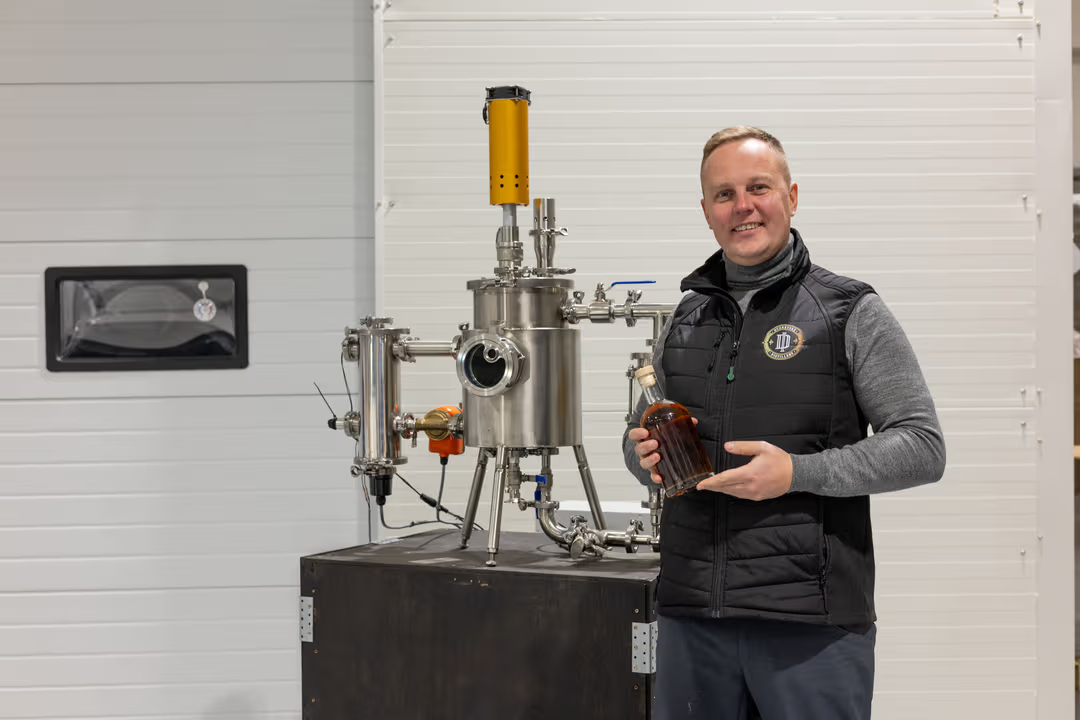
The Latvian beverage producer Dvoretsky Distillery is a family-owned company founded in 2022 that has so far offered niche products to the market—beverages crafted according to ancient artisanal methods and recipes. After many years of working with the distillate maturation process and observing both its complexity and the potentially huge market demand for innovation, the company has in recent years embarked on another development path. It has created an innovative beverage maturation acceleration reactor capable of replicating the environment and chemical processes of an oak barrel, achieving within the first days what traditionally requires a year or more in a barrel.
“Our company’s core philosophy has always been to create an alternative to mass production—characterful beverages made using traditional methods. However, working in this industry, we clearly see its challenges as well. The most expensive element in whisky, brandy, or cognac is not the raw materials—it is time! The years required in oak barrels for a beverage to acquire the desired bouquet of aroma, taste, and color. The main goal of our innovation is to accelerate this process,” says company representative Ivan Dvoreckis.
A new production facility and state support as a springboard
The past few years have been a time of change and rapid growth for the company. Last year, a new production building was acquired in Dobele Municipality, which this year—supported by funding from the Rural Support Service—was adapted to the needs of a modern distillate production facility. It has been equipped with new, state-of-the-art production equipment, and Dvoretsky Distillery moved into the new premises in September of this year.
The new facility now produces both the company’s already well-known products—a wide range of alcoholic beverages, including gin, brandy, various flavored liqueurs, and a Latvian interpretation of the traditional Korean rice drink soju—as well as new products under development. Having moved to the modernized premises, the company also plans to actively develop the non-alcoholic beverage segment.
An innovation that simulates the effect of an oak barrel
Alongside production, intensive work has been underway in recent years on the development and refinement of the beverage maturation reactor—a technology the company hopes to develop into a competitive export product in the future.
Traditionally, maturing beverages in wooden barrels is a process that cannot be fully controlled. The structure of wood fibers, temperature fluctuations, oxidation dynamics—each of these factors influences the final result and gives it a unique character. That is why producers often say that a barrel is a master craftsman—excellent, yet unpredictable.
“When a beverage is filled into a barrel, no one knows exactly what it will be like after one, two, or three years. We can forecast, but we cannot predict the final result. That is a risk, and for producers, risk means costs. Time in this process is expensive—barrels must be purchased, warehouses maintained, temperature and environmental conditions ensured, and regular testing carried out. Maturation is one of the most cost-intensive stages in the entire beverage production process,” explains Ivan Dvoreckis.
However, the newly created device does not replace this traditional process; it makes it significantly shorter and more predictable. While in a barrel a beverage is exposed for years to the interaction of natural conditions, the reactor reproduces all of this in a controlled, precisely managed environment. It simulates the impact of an oak barrel on the beverage’s flavor and color and accelerates reactions that would naturally occur only over a long maturation period. The reactor creates conditions that allow the beverage to undergo the same processes that usually take place in a barrel—release of tannins and lignins, transformation of aroma, flavor, and color, and oxidation processes. The difference is that here these processes occur much more intensively and with the ability to precisely control each parameter, enabling producers to achieve a stable, repeatable result within just a few days.
Three days in a reactor equals approximately one year in a barrel
Within the framework of an Innovation Voucher project of the Investment and Development Agency of Latvia, in cooperation with the Latvian State Institute of Wood Chemistry, a prototype of the device was created and a series of tests were carried out. “These processes, of course, depend on various factors and on the type of beverage. However, overall our testing proved that the first three days in the reactor correspond to approximately one year in an oak barrel. After that, the processes slow down and the relationship is no longer linear,” says Ivan Dvoreckis.
It is precisely this efficiency and the ability to shorten beverage maturation time that create commercial potential. The company knows that only a few companies in the United States and New Zealand are working on similar solutions, but their methodological approaches differ. Therefore, the company is currently also exploring possibilities for patenting the technological process and control methodology.
“It is important to understand—we are not claiming to replace the magic of barrels. But we can help producers save a year, a year and a half, or even two years, and then continue the process with traditional barrel maturation,” emphasizes Ivan Dvoreckis.
How does the global market assess the new technology?
The company has already showcased the newly developed device at several international exhibitions, and Ivan Dvoreckis jokes that the feedback received has been “geographically colorful.” “Europe’s classic beverage powerhouses—France, Scotland, Ireland, England—are distinctly conservative. There, value lies in tradition, and regulation is very strict. For example, whisky cannot be called whisky if it has not been matured in a barrel for at least three years. We fully understand this caution, because traditions are a value. However, in other regions of the world—and especially among large manufacturing companies—our solution is seen as having enormous potential in terms of both cost and time savings,” says Dvoreckis.
At present, the greatest interest comes from Asian markets, rum and tequila producers in Latin America, and large corporations operating at industrial production scales.
In parallel, the company is developing a marketing and international sales strategy to reach potential clients not only at exhibitions but also through direct communication. In the future, it plans to actively use LIAA export promotion programs to facilitate entry into new markets and strengthen the company’s position internationally.
The program is financed under the European Union Cohesion Policy Programme for 2021–2027, Specific Objective 1.2.1 “Strengthening research and innovation capacity and the introduction of advanced technologies in enterprises,” Measure 1.2.1.4 “Support for the development of the technology transfer system.”