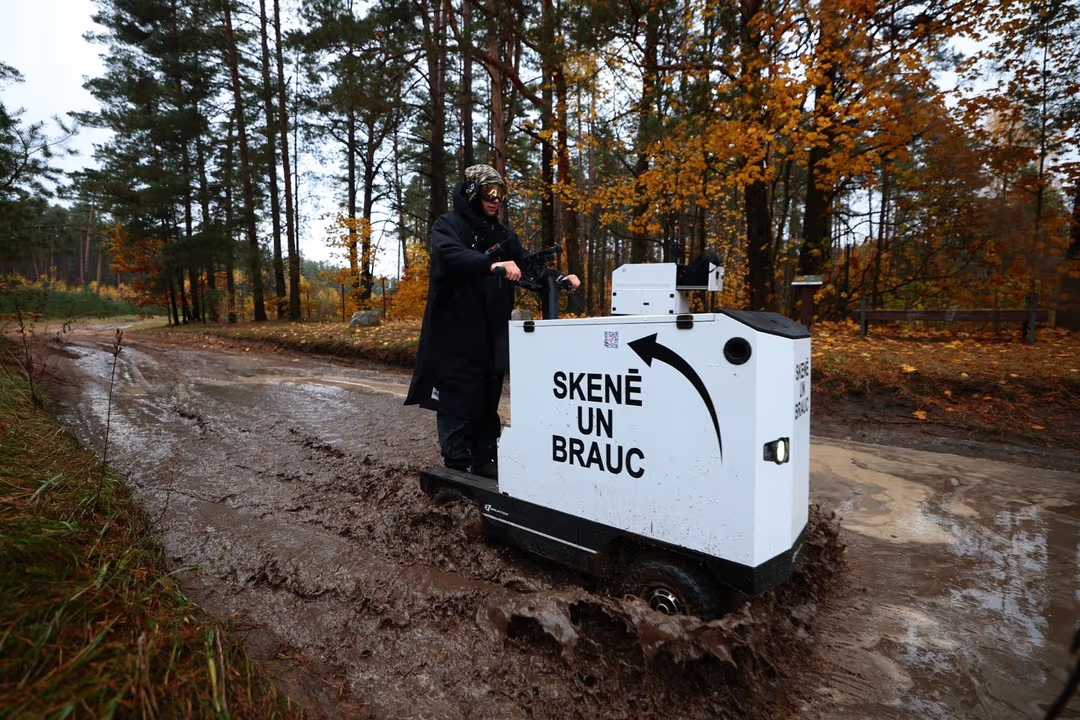
Latvian startup “Bruntor” has created an innovative cargo electric scooter designed for intensive, industrial use both in urban environments and in challenging conditions—on cobblestones, pothole-ridden streets, as well as park and forest trails. The company has already produced several dozen of these vehicles, which are being used for parcel delivery as well as for city and park maintenance work. The product is currently continuing its development through refinement and testing, while discussions are underway with several large potential clients, including the Danish postal service.
The product’s idea author and company founder, Raimonds Jurgelis, laughs that the best ideas truly do arise from necessity. The company was founded in 2021—at a time when Raimonds was already actively experimenting with various mobility solutions and working on the development of an electric skateboard. But in an everyday situation, an idea for a completely different product was born. “I needed to go pick up a heavier package for my family. The distance wasn’t long, and I didn’t want to fire up the car for such a small errand. Carrying a large load on an electric skateboard would be difficult; on foot—it would be too heavy,” he recalls. “I needed something in between: electric, environmentally friendly, but large enough to transport a serious load.” It was at that moment that the idea of an electric scooter with a cargo compartment emerged—an idea that later became Bruntor’s core product.
The first “Bruntor Cargo” scooter was built in the garage of the family home in Ikšķile, and the very first feedback on the prototype was surprisingly positive. Interest arose even before Raimonds had fully figured out how to offer this solution to the market at all. From the moment the idea was conceived to the Latvian Post’s purchase of the first test unit, only six months passed—an incredibly short cycle for a new industrial product. For Raimonds, this was the first unmistakable signal that the scooter was addressing a real, not merely theoretical, market need.
“Bruntor Cargo” is an electric scooter with a cargo box, created specifically for industrial use—parcel delivery, urban and park maintenance, and the day-to-day work of property managers and municipal services. On a single charge, it can travel up to 100 kilometers, and it can be customized to each client’s operational specifics—both in terms of cargo box size and battery capacity.
“What sets us apart from competitors is that we didn’t just take a bicycle and add a box to it,” explains Raimonds Jurgelis. “We designed the vehicle from scratch—durable, stable, and truly suitable for industrial loads. Its suspension automatically adapts to the combined weight of the rider and the cargo, significantly reducing vibrations and improving ergonomics. For delivery companies, this is critically important—if a person spends hours a day on a scooter, comfort is not a luxury but a necessity.”
The scooter handles various surfaces with ease—smooth asphalt, cobblestones, pothole-filled streets, park paths, and even light off-road conditions. “Our closest competitors operate in southern countries. We sometimes joke that they don’t know what winter, ice, and truly challenging surfaces are. ‘Bruntor Cargo’ handles all of that,” he says.
The ability to withstand Latvian weather conditions has made “Bruntor” an interesting partner for international customers as well. In its search for a faster and more ergonomic way to send and deliver parcels, the Danish postal service conducted thorough testing of the vehicle. The results were impressive: the number of deliveries per hour increased by 30% compared to traditional car-based deliveries. Moreover, by adjusting the box size and restructuring internal logistics, productivity could be increased even further. However, decisions in large organizations are not made quickly. “A new development strategy for the Danish postal service is currently being drafted and will only come into force in two years. They like the product very much, but everything is still in the testing and evaluation phase. We are hoping for a positive outcome,” Raimonds reveals.
Large deals take time, but “Bruntor” can already boast a stable customer base. Rīgas Meži uses the vehicle for park maintenance. Property managers purchase one or two units to make it easier for employees to transport tools and materials. These solutions are already being tested in urban cleaning operations not only in Riga but also in Cēsis and Limbaži. In Estonia, municipal maintenance services use them in places where there previously was no convenient alternative: “There was essentially nothing between a wheelbarrow and a quad bike with a trailer. Our model doesn’t require a driver’s license, and it’s environmentally friendly and very practical,” Raimonds says, citing customer feedback.
The company has now moved its operations to Riga, where current production facilities allow for the manufacture of up to 100 “Bruntor Cargo” units per year. As order volumes grow, capacity can be increased to as many as 400 units. The first small deals have already started to create a snowball effect—the product appears in cities, is noticed by other municipalities and companies, and interest continues to grow.
Additional momentum comes from international visibility. The company is participating in the Latvian Investment and Development Agency (LIAA) business incubator in Ogre for the first year and has used several LIAA support instruments: support for attracting highly qualified employees and support for participation in international mobility exhibitions. At one such event, “Bruntor” won the final of the European Institute of Innovation and Technology’s knowledge and innovation community EIT Urban Mobility competition “EIT Jumpstarter” in the mobility category.
The programme is financed under the European Union Cohesion Policy Programme for 2021–2027, within Specific Objective 1.2.1 “Strengthening research and innovation capacity and the introduction of advanced technologies in enterprises,” Measure 1.2.1.4 “Support for the improvement of the technology transfer system.”