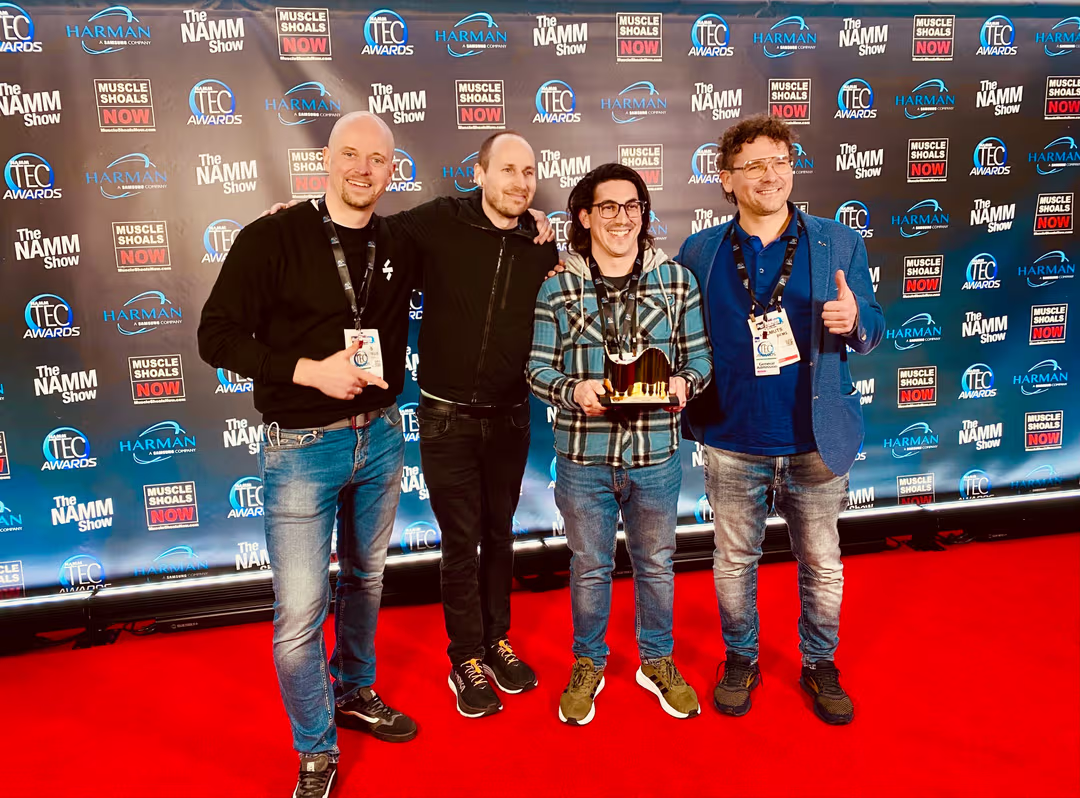
When Helmuts Bēms and “Sonarworks” co-founder Mārtiņš Popelis became interested in a sound technology prototype developed by an engineer, they had neither experience in the music industry nor any certainty that the idea could be turned into a viable business. To find out whether the technology was actually solving a real problem, they went where some of the world’s best audio professionals worked – they bought a one-way ticket to Los Angeles and started knocking on recording studio doors. More than a decade later, “Sonarworks” is an internationally recognised Latvian audio technology company whose growth has been driven by venture capital investment and continuous research, while at various stages of its development it has also used support provided by the Investment and Development Agency of Latvia (LIAA) to develop new technologies and products.
Its software is used by professionals in the music, film and gaming industries. The company has also worked with technology giants such as “Google” and “Amazon” and is currently investing increasingly in new technologies while expanding its product portfolio. In an interview with TVNET, “Sonarworks” co-founder Helmuts Bēms says the company’s next goal is ambitious – to triple the size of the business within five years.
They Knew Nothing About the Music Industry
The beginnings of “Sonarworks” were not the typical story of musicians deciding to create a technology they themselves needed. Bēms came from a business background and admits that, at the time, he had virtually no connection with the music industry.
It all began when they met an engineer who had developed a sound technology prototype. The idea seemed interesting, but Bēms and Popelis lacked the knowledge to assess for themselves whether the technology was genuinely good enough and whether anyone would actually need it.
“I had business experience, but I had nothing to do with the music industry. We liked the subject of sound and music, but we understood nothing about the industry and therefore couldn’t assess whether the technology was good or bad, whether it worked or didn’t,” says Bēms.
Initially, the aspiring entrepreneurs approached several recording studios in Latvia, but soon realised that if they were going to decide whether to potentially devote the next ten years of their lives to the idea, they needed a more convincing assessment.
What followed was one of the most significant decisions in the history of “Sonarworks”.
“As funny as it may sound, we started researching how the music industry actually works. We realised that films have the Oscars and music has the Grammys, so the most highly regarded specialists must be Grammy-winning musicians and engineers. We found that a great many of them were in Los Angeles, so we basically just bought a one-way ticket to Los Angeles,” Bēms recalls.
They spent almost a month in the United States, going from one recording studio to another from morning until evening and showing their prototype to people working at the highest level of the global music industry. They literally approached one of the first engineers with an early prototype on the streets of Los Angeles as he was on his way to the tennis courts.
Two things became clear there. First, the technology really worked and solved a problem that mattered to professionals. Second, almost nobody would want to use it in its original form.
For a Professional, Sound Is Like a Drill for a Builder
Bēms explains the problem “Sonarworks” solves with a very simple comparison. For an ordinary listener, listening to music is a source of enjoyment. For a sound engineer, producer or other professional, sound is a working tool.
“For an ordinary person, listening to music through different devices is more about enjoyment or entertainment, but for professionals, sound is like a drill for a builder. It is a tool on which they base their decisions about how music is created and what is changed in it,” he explains.
In a professional environment, hearing technically accurate sound is essential. However, simply buying expensive speakers or headphones does not fully solve the problem, because the result is also affected by room acoustics and other physical factors. “Sonarworks” technology addresses this digitally by modifying the audio signal so that professionals can hear what they are actually creating much more accurately.
In Los Angeles, the company’s founders realised there was genuine demand for such a solution. At the same time, they discovered something else that was crucial: even people who work with highly sophisticated audio technologies every day do not want to use complicated software.
“The technology worked, they understood it, and they needed it. But we realised that in the form the product had initially taken, it would never succeed as a business. It was too complicated. Even audio professionals don’t want to use complicated products. They needed something much simpler and more automated,” says Bēms.
After returning to Latvia, the founders attracted their first venture capital investment and began developing a product that much more closely reflected what the market had asked for. This principle – first talking to the people who will actually use the product and only then deciding what the product should be – has remained one of the most important elements of the “Sonarworks” business story.
From Recording Studios to YouTube Content Creators
Initially, “Sonarworks” primarily targeted the professional music industry, but over more than a decade the market itself has changed significantly. Today, the company’s customers include professionals creating sound for music, films and games – from musicians and producers to technical sound engineers.
“Our primary audience is everyone involved in the process of creating sound,” says Bēms. “Creating music is actually a form of production. It is a very complex process with many stages involving different types of people.”
Over the past five years or more, however, this professional audience has been joined by a huge new market – people creating their own content for digital platforms. These include YouTube creators, podcasters, interviewers and other content creators who may not consider themselves part of the traditional audio industry but nevertheless work professionally with both video and sound on a daily basis.
“A great many individuals are trying to create different types of content for social media. In reality, they are all professionals in video and audio content creation to some extent. As a result, our target audience has expanded in recent years,” Bēms explains.
An Industry That Can Be Turned Upside Down Every Ten Years
In the audio technology industry, one successful product is not enough. Bēms describes the music industry as an exceptionally aggressive environment where technological changes can completely reshape business models in a very short period of time.
He points to the transition from physical music formats to downloads and later to streaming. Within just a few years, such changes significantly reduced the size of the recording industry and forced companies to find entirely new ways of operating.
“You won’t find many industries where, historically, these kinds of shifts essentially happen every ten years. Change is constant,” he says.
In Bēms’ view, the ability to continuously develop new technologies is one of the main reasons “Sonarworks” has been able not only to survive but also to maintain its position in the market.
“One of the main reasons we have managed to remain in this market is that we are built on technological innovation. In the niches where we operate, we are one of the most innovative companies in the world. In some areas, we have highly unique technology that is also protected by patents,” says Bēms.
“Sonarworks” technology is already used in more than 300,000 recording studios worldwide. It is also used by more than 100 Grammy Award-winning sound engineers and producers who work with some of the world’s leading artists, including Coldplay, Adele, Lady Gaga, Madonna, Rihanna, Beyoncé, Imagine Dragons, The Killers and many others.
But being a market leader does not mean competition has diminished. Quite the opposite.
“For the First Ten Years, We Hardly Felt Any Competition”
In its early years, “Sonarworks” effectively helped create a new market niche. This gave the company a significant advantage, but over time others began following its successful direction.
“For perhaps the first ten years, we barely felt any competition. Over the past three years, we have felt it very strongly,” says Bēms.
The response to growing competition is not simply to protect the company’s existing product. Instead, “Sonarworks” is constantly trying to create something new.
“We continue to innovate, continue developing new technologies and also radically new products,” he explains.
One of these new areas is artificial intelligence. “Sonarworks” has already developed technology capable of transforming one singing voice into another.
“For example, we also have an artificial intelligence product that transforms one singing voice into another. We have significantly expanded our product range, and the only way we can remain competitive is by continuing to invest and innovate,” says Bēms.
Technology itself, however, is not the company’s only defence against competitors. Another advantage lies in the partnerships it has built over many years.
“Sonarworks” produces software, while many other companies in the industry develop headphones, speakers and other physical devices. Over the years, the Latvian company has integrated its technology with various partners’ products. Creating these integrations is complex and expensive, but that also means a new competitor cannot replicate such a network within a few months.
“Any competitor entering the market cannot immediately provide the same network of integrations with other products. These are partnerships that are very difficult for others to replicate,” Bēms explains.
Latvia – Far from Customers, but a Good Place to Develop Technology
Is building a global audio technology company in Latvia an advantage or a disadvantage? Bēms says there is no simple answer.
“I think the overall answer is neutral. There are both advantages and disadvantages,” he says.
The biggest disadvantage is geography. The company’s most important markets are the United States, the United Kingdom and Japan, and Latvia is relatively far from all three. This means the “Sonarworks” team has to travel extensively and regularly spend time in the places where the music and audio industries are concentrated.
“Every time we are there, things start moving forward much faster, and we always think how good it would be if we could be here all the time,” says Bēms.
At the same time, Latvia has an important advantage: for a country of its size, it has a surprisingly strong music technology sector and highly qualified technical specialists.
“We have a large number of companies in this industry, which gives us both an understanding of the market and opportunities to exchange information with one another. Latvia has enough technical expertise to build products like these,” he says.
Latvia is no longer a low-cost software development country, but Bēms believes its balance between quality and cost remains competitive. He even questions whether this type of niche company could be successfully built in Silicon Valley, where the cost of highly qualified technical talent is considerably higher.
“This is still a relatively small, niche industry, and companies in it cannot afford to pay San Francisco salaries to all their technical staff. From that perspective, Latvia is an advantage,” Bēms explains.
From “Google” and “Amazon” to Hundreds of Thousands of Individual Users
The “Sonarworks” business model is unusual in that its product is highly professional, yet its sales model largely resembles a B2C business, with the software purchased by a large number of individual end users.
As a result, the company is not currently dependent on one or two customers accounting for a significant share of its business.
“We sell to end users. We don’t have a single large customer, apart from our integration partners. But in 2023 and 2024, we worked with ‘Google’ and ‘Amazon’, supplying them with our technology in various ways. During those years, they were also our largest customers,” says Bēms.
Today, the company is once again focusing more strongly on the professional audio industry and its broad base of individual users.
LIAA Support Has the Greatest Impact When a Company Is Still Vulnerable
Much of the “Sonarworks” development journey has been financed through private venture capital, but the company has also used support opportunities provided by the Investment and Development Agency of Latvia (LIAA) at various stages. Bēms emphasises that such programmes make the greatest difference at the very beginning of a company’s journey.
“I think we have used some form of support throughout our development. It helps. But overall, I would say the greatest benefit was at the very beginning, when a company is small and highly vulnerable. At that stage, support programmes have the greatest impact on a company,” he explains.
“Sonarworks” has continued to use support instruments at later stages as well, particularly for the development of new and technologically complex products. This is especially important for the company because maintaining competitiveness requires continuous investment in research and development.
“We invest heavily in research to maintain our technological advantage. From time to time, there have been programmes specifically supporting the development of innovative technologies,” says Bēms.
One such instrument is LIAA support for start-ups to attract highly qualified employees. In the case of “Sonarworks”, the support is linked to the further development of an existing minimum viable product (MVP) into a high value-added audio technology solution.
Products of this kind require highly specialised expertise in software development, audio technologies, research and the latest artificial intelligence methods. People capable of developing technologies that competitors have yet to create therefore become one of the company’s most important resources.
After Ten Years of Venture Capital, the Company Is Standing on Its Own Feet
Perhaps one of the most important achievements of “Sonarworks” cannot be seen in its patents, awards or customer lists. After approximately ten years during which the company’s growth was also financed through venture capital investment, “Sonarworks” has become profitable over the past two years.
“For the first ten years, the company was financed by venture capital. Today, the company has become profitable. We are now standing on our own feet,” says Bēms.
This also represents a significant change in the company’s development model. New products and growth are increasingly being financed from the company’s own earnings rather than external investment.
At the same time, “Sonarworks” does not want to become a company that relies on a single successful product. Its portfolio currently includes several product lines, with another planned for release by the end of the year. Bēms aims to approximately double the company’s product portfolio over the next five years.
There is also a very pragmatic business rationale behind this approach. Over more than a decade, the company has already built an international customer base and a recognised brand. If “Sonarworks” can develop new products in other audio technology niches, it does not have to start selling them entirely from scratch – the company already has an audience that knows and trusts it.
“Our advantage is that we already have a customer base. If we can innovate in other product areas, we can use our existing customer base to bring new products to market much faster,” Bēms explains.
“I would like to triple the size of the business over the next five years and continue expanding our product portfolio,” says the entrepreneur.
Information for Businesses
Latvian companies and start-ups have access to a range of support instruments provided by the Investment and Development Agency of Latvia for business development, innovation and exports, including support for start-ups to attract highly qualified employees. Information about current programmes, their eligibility requirements and application procedures is available on the unified business portal business.gov.lv and at liaa.business.gov.lv.
This article was produced in cooperation with LIAA.
The project is co-financed under Measure 1.2.1.4 “Support for Improving the Technology Transfer System” of Specific Objective 1.2.1 “Strengthening Research and Innovation Capacities and the Uptake of Advanced Technologies by Enterprises” of the European Union Cohesion Policy Programme 2021–2027.