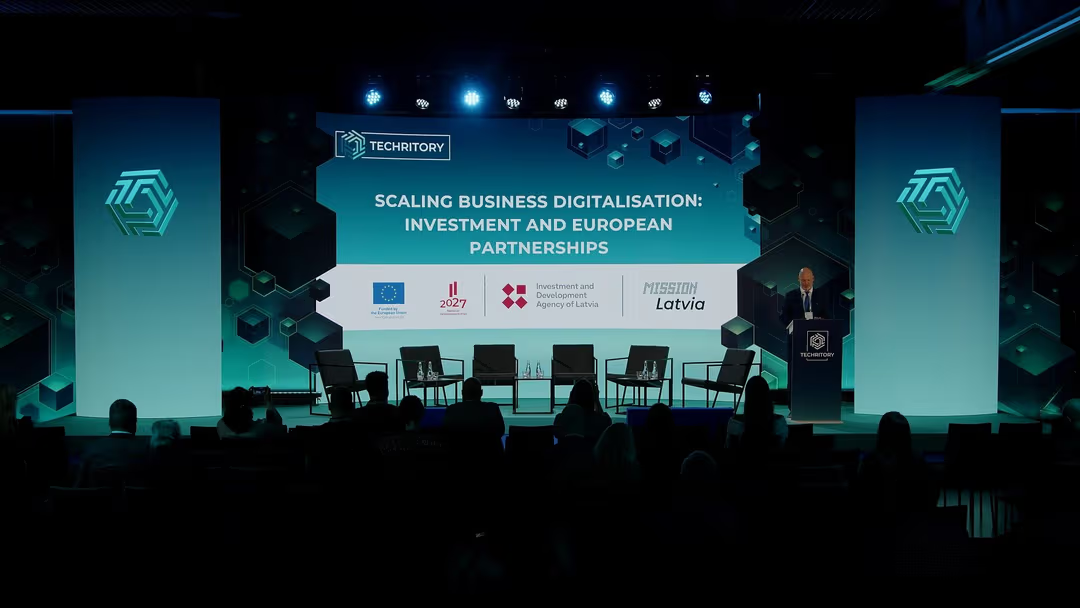
The potential of artificial intelligence becomes a competitive advantage only when it is put into practice. This year’s Techritory discussions highlighted the next stage: success will belong not to those with access to the latest technologies, but to those who can turn them into everyday business tools the fastest.
From Artificial Intelligence (AI) Potential to Tangible Business Benefits
In recent years, artificial intelligence has moved beyond laboratories and technology giants to become accessible to almost every business. Language models, analytics tools and automation platforms are now more affordable than ever. However, accessibility alone does not create value.
What increasingly sets businesses apart is their ability to integrate technology into their operations – from customer service and sales to manufacturing and internal management. This is where digitalisation translates into measurable results: higher productivity, lower costs, improved customer experience and new services.
Europe’s competitiveness in the global market will depend on how quickly businesses and the public sector can turn the potential of AI into practical solutions. This is particularly relevant for Latvia, whose economy is largely driven by small and medium-sized enterprises (SMEs).
Expert Perspectives: Moving from Experimentation to Everyday Practice
During Techritory 2026, experts agreed that the adoption of AI in business has reached a turning point. Most companies have already experimented with individual tools, but the priority now is to move from testing to systematic implementation.
In practice, this involves three main areas. The first is automating repetitive processes, such as document processing, invoice preparation and sorting customer enquiries. The second is data-driven decision-making, where AI helps identify trends that people might otherwise overlook in their daily work. The third is developing new services that would not be possible without technology.
“The value of digitalisation for a business is determined by measurable results – more efficient processes, higher productivity and new market opportunities. European funding and partnerships can help turn a successful pilot project into a widely adopted solution, provided that support is clear, accessible and aligned with the company’s development needs,” says Egita Aizsilniece-Ibema, Head of the Investment and Development Agency of Latvia (LIAA) Representative Office in Brussels and moderator of the panel discussion.
However, the journey is not without obstacles. Experts most frequently highlight a lack of knowledge and skills, limited financial and human resources, and insufficient data quality – an AI solution can only be as good as the data on which it relies.
At the same time, digital transformation is no longer an advantage reserved for large companies. SMEs, with their shorter decision-making processes, can often implement new solutions more quickly.
Business Experience: How Digitalisation Works in Practice
The experiences of Latvian businesses reinforce the experts’ conclusions. Companies from different sectors – from document processing to construction – demonstrate how specific business needs can be transformed into digital solutions with tangible results.
SIA “Posttech”: Making a Paper Letter as Easy to Send as an Email
SIA “Posttech” is developing DigiPasts, a platform that connects electronic document submission with the physical preparation and dispatch of letters.
With LIAA support under the European Regional Development Fund (ERDF) co-financed project “Support for Process Digitalisation in Latvia” (No. 1.2.2.1/1/25/I/001), the company is implementing an AI solution project with total costs of EUR 400,000.
The challenge. The company processes large volumes of customer documents every day, including invoices, notifications and business correspondence. Receiving and sorting documents, verifying addresses and preparing files for printing required considerable manual work. In addition, customers use different systems and file formats. A unified, standardised process was needed to handle large volumes of data.
The solution. The DigiPasts platform digitally manages document processing, address verification, consolidation, sorting and preparation of print-ready files. Customers can submit documents, track their processing status and receive reports in one place. Printing operators receive files that have already been sorted and can immediately begin printing and packaging.
The results. Operators no longer need to sort documents or prepare print files manually. The platform processes documents according to customer settings and sorts them in line with Latvijas Pasts requirements.
Automatic address verification using the State Land Service database significantly reduces the number of returned mail items, lowering customer costs and speeding up delivery. A secure digital archive makes it possible to check historical mailings and retrieve reports at any time.
“Operators no longer need to manually sort documents or prepare print files – all that remains is to print and package them. For customers, transparency, data accuracy and security are essential. Our goal is to make sending a paper letter as simple as sending an email,” says Edvards Mekšs, Chairman of the Management Board of SIA “Posttech”.
Next steps. The company plans to integrate DigiPasts more closely with customers’ internal systems to minimise manual work in document processing. Continuously improving security standards is an equally important priority.
“Cyber threats are changing and attackers’ methods are evolving, so we see security as an ongoing responsibility and an integral part of the platform’s development. We regularly assess and improve our protective measures to maintain customer trust and prepare for emerging risks,” emphasises Edvards Mekšs.
SIA “UPB Nams”: Artificial Intelligence in Construction
SIA “UPB Nams” is a general construction contractor belonging to the Liepāja-based UPB Group. The company has received EUR 18,000 in LIAA support under the ERDF co-financed project “Support for Process Digitalisation in Latvia” (No. 1.2.2.1/1/25/I/001).
Chairman of the Management Board Kaspars Rožkalns emphasises that digitalisation has considerable potential in the construction industry. Many solutions are still evolving, and it is not yet clear which will become widely adopted. State support can therefore play a decisive role by enabling companies to experiment in several areas simultaneously. He also notes that the industry as a whole is moving in the right direction.
The challenge. The sales team works with large volumes of information every day. Processing this information took time that specialists could otherwise devote to tasks requiring an individual approach and professional judgement.
The solution. The company is developing and implementing an artificial intelligence system that automates the processing of large volumes of information in the construction sales process.
The results. The solution has been successfully integrated into the company’s daily operations. It significantly speeds up the team’s work, allowing specialists to spend more time on tasks requiring an individual approach, professional judgement and manual involvement.
“Accuracy is the most important thing in construction – right from the beginning of the process, particularly when planning project costs and organising design work. Artificial intelligence is a tool that, when used correctly, helps prevent mistakes. In large projects, even a 1% error can amount to millions. AI must be used responsibly and made to work for the benefit of the company,” emphasises Kaspars Rožkalns.
Next steps. The new system forms part of a broader digitalisation strategy. As part of this strategy, SIA “UPB Nams” is also introducing other IT innovations, including automated construction site scanning to identify discrepancies.
The experiences of both companies point to a shared conclusion: successful digitalisation begins with a clearly defined business problem, not with the choice of technology.
For small businesses, access to grants is often the decisive factor that makes such investments possible in the first place.
LIAA and ERDF Support: The First Steps Are the Hardest
One of the biggest barriers to implementing digital solutions is the initial investment. Businesses must commit funding, time and staff resources before the benefits become visible. Public support can be decisive at precisely this stage.
Under the ERDF co-financed project “Support for Process Digitalisation in Latvia”, LIAA implements the support programme “Support for Process Digitalisation and Artificial Intelligence Solutions”.
The programme provides grants of up to EUR 10,000 or EUR 200,000, depending on the type of support.
Support is available to micro, small and medium-sized enterprises, as well as certain mid-cap companies, associations and foundations.
Funding can be used to digitalise and automate business processes, including data management, manufacturing, quality control, resource management, and the development and implementation of other digital solutions, as well as artificial intelligence solutions.
Applications were submitted electronically through the business.gov.lv platform, with the application period closing on 7 November 2025. Implementation of the approved projects is currently ongoing.
“Digitalisation is not an end in itself – its purpose is to help businesses operate more efficiently, reduce costs and strengthen competitiveness. The ERDF support programme enables companies to make targeted investments in process automation, data management and artificial intelligence solutions.
This is particularly important for SMEs, for which initial investment costs and the risks associated with adopting new technologies often represent significant barriers.
Our aim is not only to encourage the introduction of individual digital solutions, but also to improve companies’ productivity and their ability to compete in Latvian and international markets over the long term,” explains Inese Gribanova, Manager of the “Support for Process Digitalisation in Latvia” project and Programme Coordinator at the Innovation and Projects Division of LIAA’s Export and Innovation Services Department.
Achievements to date. A total of 792 agreements have been concluded under the programme, and by October 2026, 346 companies had already received support. Of the EUR 18 million available for the project, 21%, or approximately EUR 4 million, has been disbursed in grants.
Expected impact. The project aims to increase business productivity by improving access to funding for process digitalisation and targeted investments that generate higher added value.
In the long term, digital solutions are expected to help businesses increase labour productivity, optimise resource use, reduce administrative burdens and production costs, and develop new products and services.
This will strengthen the competitiveness of Latvian businesses and their ability to adapt to technological change.
The Next Step: From Individual Projects to Long-Term Strategy
Experts and entrepreneurs agree on what is needed next. For digitalisation to become a lasting competitive advantage, five key conditions must be met:
Integrating AI and automation into everyday operations – moving beyond standalone tools towards solutions embedded in business processes.
Developing employees’ digital skills – technology creates value only when people know how to use it and are willing to do so.
Ensuring high-quality data and security – responsible AI adoption begins with well-organised data and clear security requirements.
Providing appropriate financing – public support helps businesses take the first step and reduces investment risks.
Establishing a long-term strategy – enabling businesses to move from individual projects towards systematic digital transformation.
Aiga Irmeja, Chairwoman of the Board of the Latvian IT Cluster, who also represents a European Digital Innovation Hub, emphasises that digitalisation support must not focus exclusively on the most technologically advanced companies.
It is equally important to support a broader range of businesses that need to organise their data and internal processes and introduce digital tools.
Digital transformation is not a one-off technology procurement project. It is a continuous process that determines a company’s ability to adapt to market developments and compete internationally.
The businesses that begin this journey today will help drive Latvia’s economic growth tomorrow.
This publication is co-financed by the European Regional Development Fund under the project “Support for Process Digitalisation in Latvia” (Project No. 1.2.2.1/1/25/I/001).
The views and opinions expressed are those of the author(s) only and do not necessarily reflect those of the European Union or the European Commission. Neither the European Union nor the European Commission can be held responsible for them.