Latvian startup “instadial” has developed an artificial intelligence (AI) voice assistant capable of both receiving and initiating phone calls, conducting full conversations with customers, booking services, and automating a range of customer service processes. The solution was initially developed for the healthcare sector, where healthcare providers face high volumes of incoming calls and the need to remind patients about upcoming appointments. However, the company is already working to adapt the product for the insurance, real estate, and other service industries.
The solution functions as a virtual customer service assistant capable of holding full conversations with customers, understanding natural, free-form speech, and responding to a variety of requests. Before implementation, it is tailored to the specific needs of each company and integrated with its customer service and appointment booking systems. This means that the assistant can not only answer questions about services but also offer available appointment times with specific specialists, book, reschedule, or cancel appointments, and send customers a summary of the conversation by text message or email. The solution can handle up to 100 calls simultaneously.
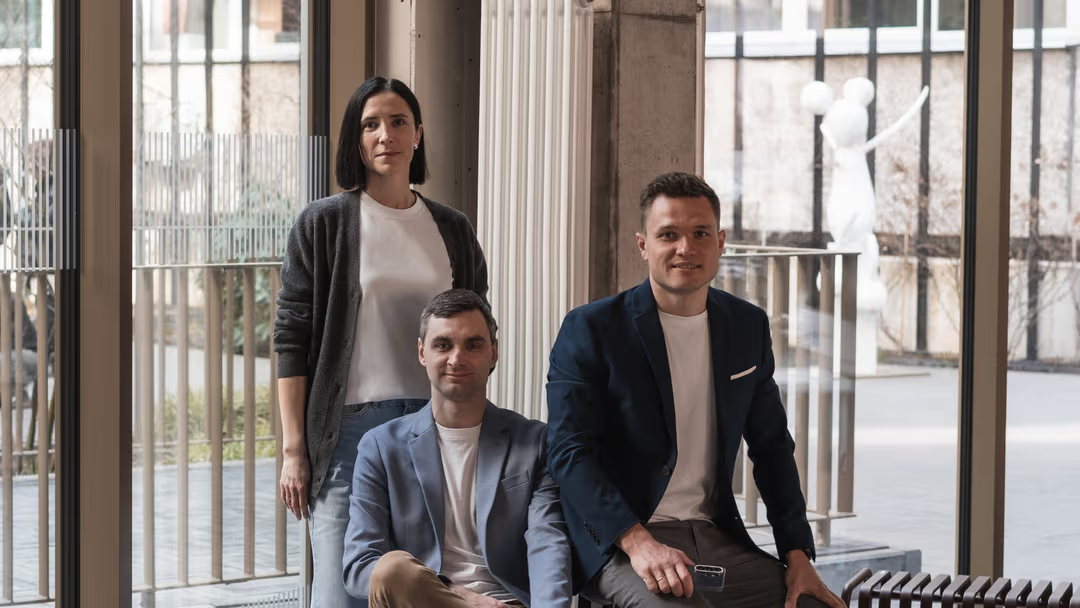
The core team behind “instadial” consists of three co-founders – Olga Ļesņikoviča-Riņķe, Jānis Cīrulis, and Klāvs Slavenieks – bringing together expertise in business development, sales, and artificial intelligence technology. The idea for the solution emerged at an AI hackathon in late 2025. Initially, the team worked on a solution for automated reminder calls, but it soon became clear that the technology had much broader potential.
“We saw that clinics and other service providers were losing customers every day not because of poor service, but simply because they were unable to answer every call. We realised that this was a problem we could solve with artificial intelligence,” says O. Ļesņikoviča-Riņķe.
After winning the hackathon, the team focused on product development and market validation, working with healthcare providers and testing the solution in real-world conditions. The first pilot projects demonstrated strong interest from the sector, and the company was established in March this year, marking the start of active product commercialisation. Just a few months after its establishment, “instadial” has already carried out pilot projects in more than 10 clinics in Latvia, secured its first paying customers, and continues discussions with potential partners in both healthcare and other industries.
“We are not promoting this as a way to replace people. Our goal is to reduce routine workloads and allow administrative staff to devote more time to patients and more complex tasks. Every project begins with an assessment of the client’s workflows – we identify the types of calls the company receives, the information customers need, and the systems already in use. The AI assistant is then tailored to the company’s specific needs, trained to work with the necessary information, and integrated into existing systems. This enables it not only to answer questions, but also to book, reschedule, or cancel appointments and perform other customer service functions,” explains the company’s CEO.
When the company was established in March this year, “instadial” also joined the business incubation programme of the Investment and Development Agency of Latvia (LIAA). According to the company’s CEO, when a product is transitioning from an idea into a commercial solution, access to expert advice, development support, and opportunities to discuss business growth strategies with experienced professionals is particularly valuable.
Although the company initially focused on healthcare, during its pilot projects the team discovered that similar challenges affect a much broader range of service companies. Therefore, alongside its work with healthcare providers, “instadial” is currently developing partnerships with companies in the insurance, real estate, and other industries where telephone-based customer service plays an important role in day-to-day operations.
“The more we spoke with companies from different industries, the more we realised that this problem is not unique to healthcare. Our team has presented the solution to representatives of the Ministry of Health, discussing the potential of artificial intelligence to improve healthcare communication processes at the national level. Such discussions with industry institutions provide valuable feedback and help us refine the solution to ensure that it meets the sector’s needs and priorities. Real estate agents, insurers, and other service providers also receive large volumes of calls every day and are not always able to answer them immediately. In the real estate sector, for example, a virtual assistant can become a valuable support tool for an agent – it can have detailed knowledge of all available properties, including their prices, size, location, and other features, allowing it to answer most questions from potential buyers or tenants before they even speak to an agent. If a customer is interested in a particular property, the assistant can immediately schedule a viewing or a call,” says O. Ļesņikoviča-Riņķe.
The company believes that within the next few years, AI voice assistants will become as commonplace in customer service as chatbots and online booking systems. While an increasing number of similar solutions are entering the market, the decisive factors for competitiveness will be quality, security, and the ability to integrate seamlessly into companies’ day-to-day operations.
“Some people are already comfortable speaking with a virtual assistant, while others still prefer communicating with a person. That is completely understandable, as we are currently seeing a shift in habits. However, it is clear that AI solutions will gradually play an increasingly important role in customer service. AI technologies have become much more accessible in recent years, so the number of competitors in the market is also growing. But technology alone is not enough. Customers need to know where their data is stored, how it is processed, what security requirements are followed, and who is responsible for the operation of the solution. This is particularly important in healthcare and other sectors that routinely handle sensitive information,” emphasises O. Ļesņikoviča-Riņķe.
The company therefore places particular emphasis on data security and compliance with regulatory requirements and is also preparing to obtain international certification.
The “instadial” assistant currently operates in Latvian, English, and Russian. The company considers its ability to work effectively in Latvian to be one of its key competitive advantages, as most international solutions are primarily developed for larger markets, while high-quality voice assistants adapted to smaller languages remain relatively scarce.
Although the company is already attracting interest from abroad and has begun initial discussions with potential partners in Lithuania, Estonia, Poland, and Germany, its immediate priority is to strengthen its position in the Latvian market. The company believes that the domestic market provides the right environment to further refine the product and build experience before pursuing more rapid international expansion.
This article has been prepared within the framework of the project “Innovative Entrepreneurship Development for SMEs”, co-financed by the European Regional Development Fund and the European Union.