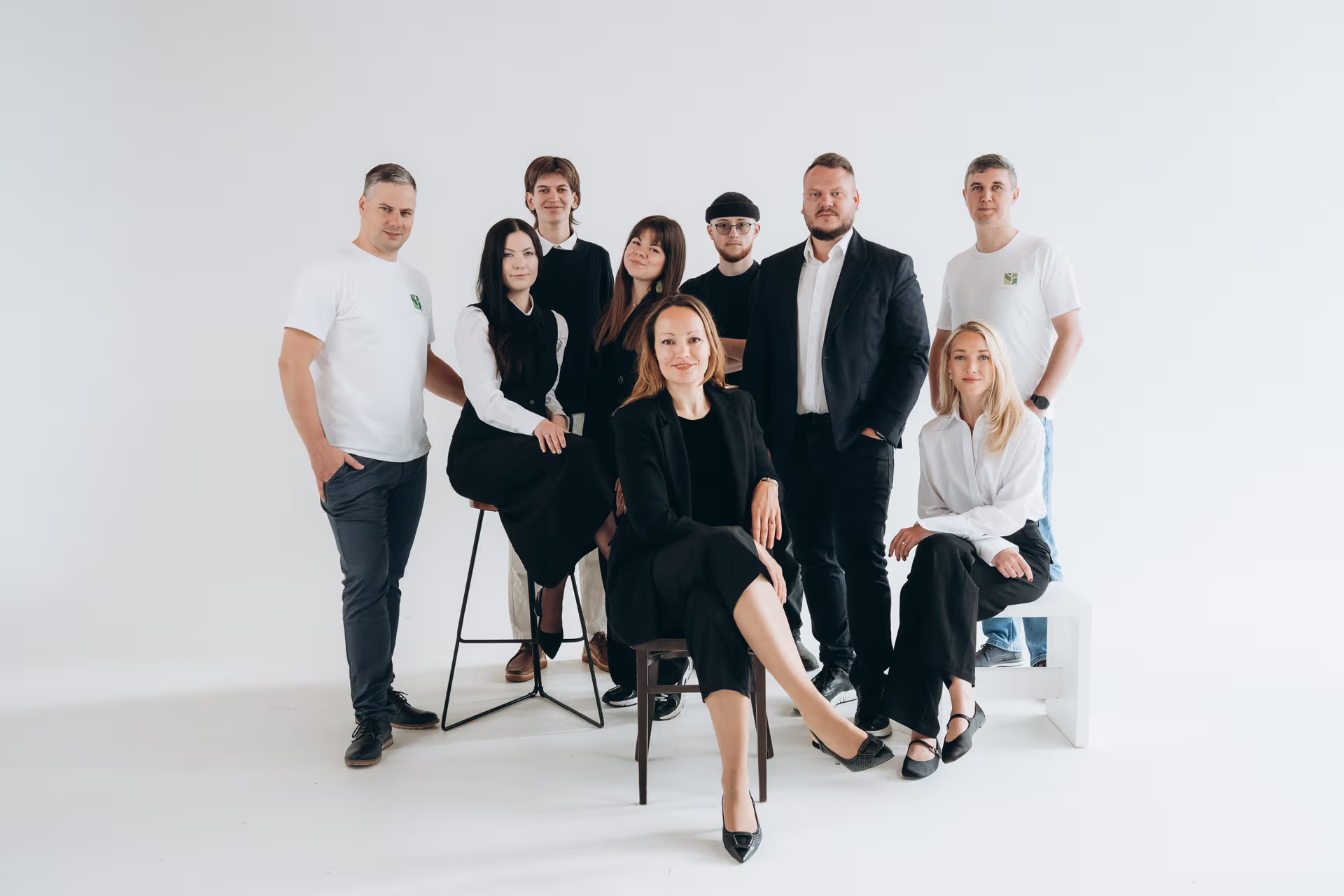
Latvian biotechnology company “Alternative Plants” develops and produces active ingredients for the cosmetics industry by cultivating plant cells and microalgae under laboratory conditions. Its customers include ingredient distributors and cosmetics manufacturers operating in various international markets. In Latvia, the company’s ingredients are also used in products by “MADARA Cosmetics”. The company’s domestic and export sales currently account for roughly equal shares of its business, but it sees its future growth opportunities primarily in export markets.
To develop new multifunctional cosmetic ingredients, “Alternative Plants” used support from the innovation voucher programme of the Investment and Development Agency of Latvia (LIAA). The project was implemented in cooperation with Rīga Stradiņš University, whose specialists carried out extensive analyses of the chemical composition of prototypes developed by the company, as well as dermatological safety and efficacy studies. Cooperation with the scientific institution also gave the company access to specialised equipment that would have been disproportionately expensive to maintain in-house.
“Without the innovation voucher, we would most likely have carried out these studies ourselves, but much more gradually and at a slower pace. The support enabled us to accomplish significantly more within a single project, accelerate the development of new ingredients, and obtain the data needed both to improve our products and for discussions with distributors and cosmetics manufacturers,” says Anna Ramata-Stunda, co-founder of “Alternative Plants”.
The company also has a positive assessment of the practical aspects of working with LIAA. The application and reporting process through the liaa.business.gov.lv platform was convenient, while any questions could be discussed promptly with LIAA staff. This was particularly important because the project results included extensive and highly specialised scientific data.
“In my view, the process has become much more convenient and user-friendly. If questions arose about the materials we had submitted, we could simply discuss them rather than having to resolve everything solely through a formal exchange of letters. This, of course, significantly speeds up and simplifies the reporting process for such a complex scientific project,” says Anna Ramata-Stunda, describing the company’s cooperation with LIAA.
“Alternative Plants” has also worked with LIAA previously, including using the support of the agency’s representative offices abroad to identify potential cooperation partners and establish contacts.
“Support from LIAA’s representative offices has been particularly useful to us in markets where the local language plays an important role, such as France and German-speaking countries. The representative offices have helped us identify potential companies, obtain contacts, and progress to discussions with distributors and cosmetics brands, which is, of course, invaluable support,” says Anna Ramata-Stunda.
The programme is funded under Measure 1.2.1.4 “Support for Improving the Technology Transfer System” of Specific Objective 1.2.1 “Strengthening Research and Innovation Capacities and Introducing Advanced Technologies in Enterprises” of the European Union Cohesion Policy Programme 2021–2027.