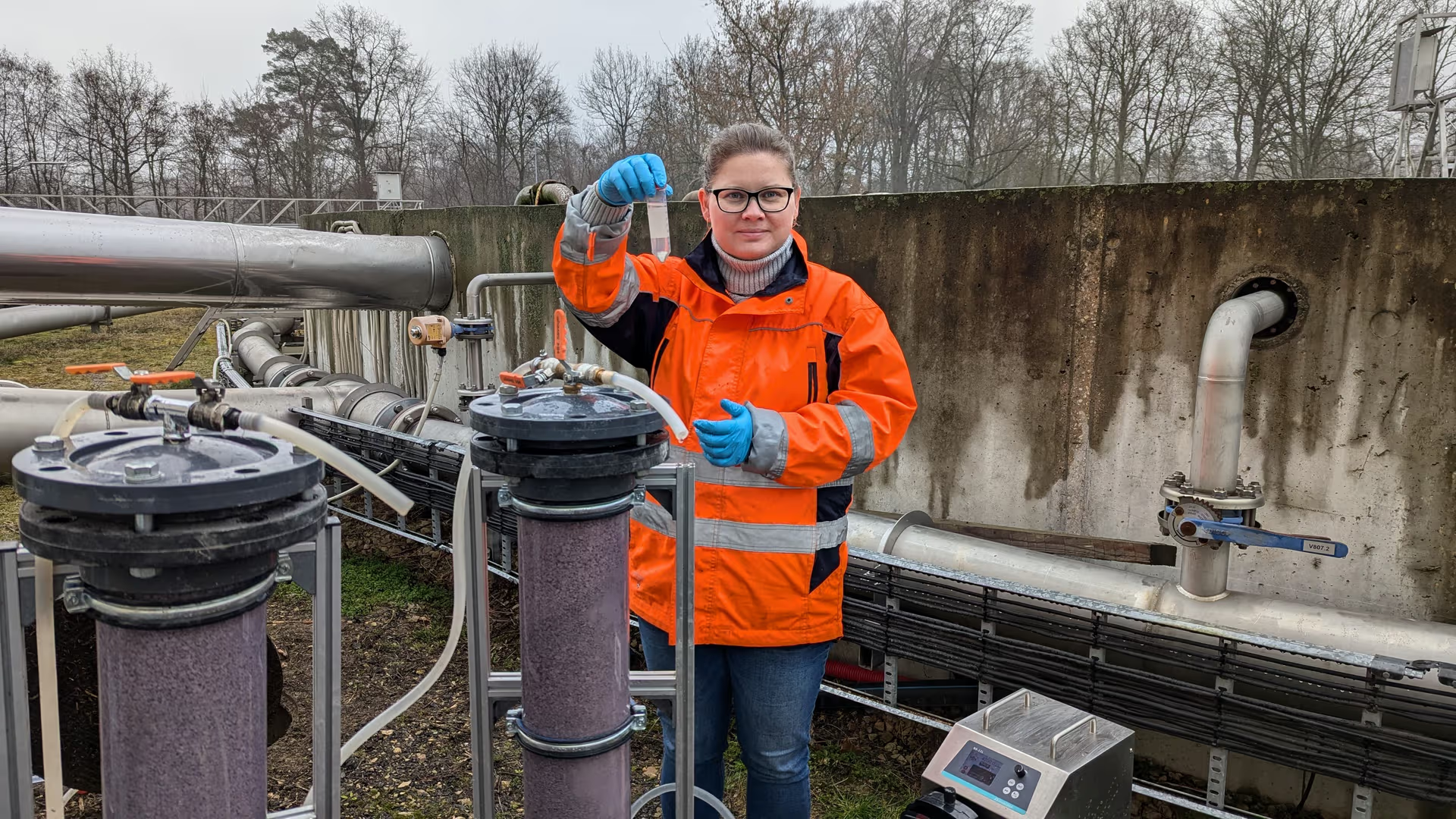
Latvian science-based start-up “P-Agro Minerals” is developing a technology that removes phosphorus from wastewater and enables the recovered resource to be reused in agriculture. The company’s solution is based on a mineral material called letonite, which captures phosphorus from water during the filtration process. The company is currently testing a pilot system in cooperation with “Ādažu ūdens”, capable of treating up to 20 cubic metres of wastewater per day. The company plans to commercialise the technology within the next two to three years.
“P-Agro Minerals” has used several support instruments provided by the Investment and Development Agency of Latvia (LIAA) to develop its technology. The company has completed its first year in the business incubation programme of LIAA’s Saldus Representative Office, where the support provided has helped it develop a new and significantly more powerful pilot system.
“Just a year ago, our prototype was capable of treating approximately one cubic metre of wastewater per day, but with the support of the incubation programme, we have developed a next-generation system capable of treating up to 20 cubic metres per day. For a science-based company, this type of funding is particularly important because several stages of research, testing and scaling have to be completed before the first market-ready product can be launched,” says Annija Emersone, CEO of “P-Agro Minerals”.
The company has also used a LIAA innovation voucher to continue developing its second planned product – a phosphorus-enriched soil improvement product. As the specific research expertise required could not be found in Latvia, the company began cooperating with the Austrian Institute of Technology. During the approximately six-month project, the properties of phosphorus recovered from wastewater and its suitability for agricultural use were studied, including greenhouse trials involving the cultivation of tomatoes.
“The innovation voucher helped us gain the knowledge we needed to understand exactly what kind of material we recover from wastewater, how the phosphorus it contains becomes available to plants, and which crops and soil types it may be best suited for,” explains A. Emersone.
The company also has a positive overall assessment of the practical and administrative aspects of using state support instruments. With the assistance of LIAA consultants, it was able to successfully meet all the requirements.
“At first, it was easy to get lost in the extensive documentation and forms, but we had a dedicated LIAA consultant who helped us understand the application process in a very clear and approachable way. She explained how to prepare the application, what information was important for the evaluation committee to receive, and what we should focus on. Overall, our experience of working with LIAA has been very positive,” emphasises A. Emersone.
The programme is funded under Measure 1.2.1.4 “Support for Improving the Technology Transfer System” of Specific Objective 1.2.1 “Strengthening Research and Innovation Capacities and Introducing Advanced Technologies in Enterprises” of the European Union Cohesion Policy Programme 2021–2027.