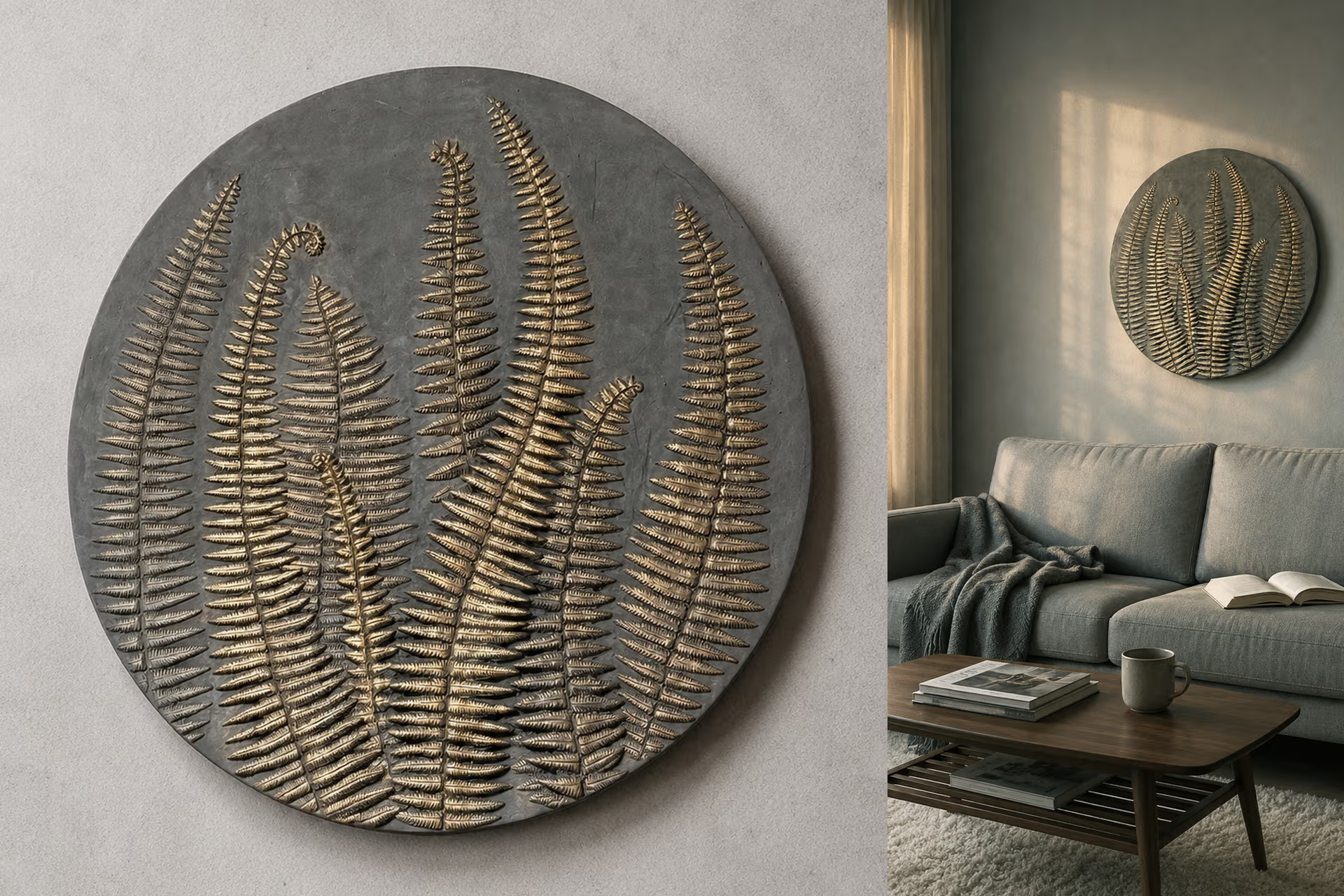
Sigulda-based company IK “Forest Wonders”, which operates under the “Daba Deco” brand, creates three-dimensional wall decorations inspired by Latvia’s forests and meadows – animals, flowers, leaves and mushrooms. Around 90% of the company’s products are exported, while founder Silvija Stade sees the brand’s next stage of growth in expanding cooperation with interior designers, architects, concept stores and hospitality businesses.
Silvija is an interior designer by education and profession and has worked in the field both in Latvia and abroad. While developing interior solutions for clients, she repeatedly found that modern three-dimensional wall decorations were not easy to find, and it was even more difficult to find designs that reflected Latvian nature in a contemporary way. After returning to Latvia, she decided to create such interior elements herself, drawing inspiration from the forests and meadows surrounding her home in Sigulda.
The first design in the “Daba Deco” collection was a hare, soon joined by other animals found in Latvia’s forests. The product range was later expanded to include meadow flowers, leaves and mushrooms. Today, the collection includes around 11–12 flower designs and five animal designs, as well as several smaller decorative pieces. The chanterelle has proved particularly popular with customers and has also inspired the brand’s first decorative lighting product – a chanterelle-shaped wall lamp.
All decorations are handmade in Silvija’s workshop in Sigulda. First, the original design is sculpted from modelling material and a mould is then made from it. A liquid polymer gypsum mixture – gypsum powder combined with acrylic resin – is poured into the mould. Once the material has hardened, each decoration is removed from the mould, carefully finished and, where necessary, hand-painted. The moulds allow the same design to be reproduced and larger quantities of individual elements to be made when required, but every piece is still finished and processed by hand.
According to the company’s founder, the decorations can be purchased individually or as ready-made sets and can also be freely combined to create a composition tailored to a particular space. Each flower is attached to the wall separately, meaning there is no fixed frame or size for the composition – it can be arranged in different shapes, supplemented with additional elements and expanded over time. This approach makes it possible to create anything from a small decorative accent to a large-scale wall installation. One of the company’s largest orders to date was sent to the Netherlands, where 91 flowers were produced for a composition measuring approximately 4 × 5 metres.
Silvija took her first steps in entrepreneurship gradually, initially offering her work through the international online marketplace “Etsy”. This enabled her to test customer interest and confirm that decorations inspired by Latvian nature could appeal to people far beyond Latvia’s borders. Looking for opportunities to develop the idea in a more focused way, Silvija responded to an invitation from the Sigulda Representative Office of the Investment and Development Agency of Latvia (LIAA), initially joining the pre-incubation programme before becoming a participant in LIAA’s business incubation programme in November 2024.
Silvija acknowledges that admission to an incubation programme is not necessarily straightforward for creative businesses – alongside the originality of the idea, applicants must also be able to demonstrate the product’s potential for growth and export. “Daba Deco” succeeded in doing so, and participation in the programme has given the company’s development new momentum. It has helped the business define its target customers more precisely, organise its sales channels, increase brand visibility and prepare more strategically for international markets. With LIAA’s digitalisation support, the company has also developed a new website and online store.
As the company grows, its sales channels continue to expand. Alongside “Etsy” and its own online store, “Daba Deco” products are now available through the international design and wholesale platforms MOM, or “Maison&Objet and More”, and “Faire”. These platforms also help the brand reach concept stores, interior designers and other professional customers looking for distinctive interior products created by smaller independent brands.
Although Latvian nature lies at the heart of “Daba Deco’s” designs, most of its customers are currently based abroad. According to the company’s estimates, around 90% of its products are exported. The United States is its largest market, while orders are also regularly shipped to France, the Netherlands, Germany, Portugal and the United Kingdom. Some pieces have travelled as far as Australia.
“I would be very happy to sell a larger share of our products here in Latvia, where customers particularly appreciate their local origin, but I understand that growth also means looking beyond Latvia’s borders. Latvian nature is at the heart of our brand, but nature-inspired motifs resonate with people all over the world. The brand also benefits from a growing trend among consumers to look for and choose items made by human hands rather than mass-produced by machines. This is a trend we are seeing in both the Latvian and international markets,” says Silvija.
To give customers an opportunity to experience the products in person, the company participates in local design and craft markets, including the Contemporary Craft Market at the Ethnographic Open-Air Museum of Latvia, as well as interior and design exhibitions. In September 2026, “Daba Deco” plans to take the next step in building its international profile by participating in the “Habitare” design fair in Finland. The company’s stand will be located in the professional section of the exhibition, where Silvija hopes to establish contacts with interior designers, architects, concept stores and representatives of the hospitality industry.
This article was produced within the framework of the project “Development of Innovative Entrepreneurship for SMEs”, co-financed by the European Regional Development Fund and the European Union.